 Single Vial Peptides
Who is selling compounded GLP-1s, and who actually got a letter
The four-prescription figure is not a per-patient allowance, and it is not how this market operates.
On its April 1, 2026 compounding page, the FDA said it does not intend to take action against a compounder for making what is essentially a copy of a commercially available drug, "regularly or in inordinate amounts," if that compounder fills four or fewer prescriptions of that compounded product during a calendar month. The count is the pharmacy's. It is one drug product. It is one month. A med spa that sees hundreds of people a week cannot put those visits inside four fills. FDA, compounding policy as the GLP-1 supply stabilized.
That sentence is also only the pharmacy path, section 503A. An outsourcing facility under section 503B does not get a four-prescription cushion. FDA's rule for those facilities is that they generally cannot compound from bulk unless the substance is on the 503B bulks list or the drug is on the shortage list. On April 30, 2026 the FDA proposed to keep semaglutide, tirzepatide, and liraglutide off that list, because it found no clinical need. The shortages were already over. A 503B facility still turning out those copies from bulk is outside the conditions of that section. FDA, April 30, 2026.
What the clinics were actually offering
After the deadlines, University of Colorado researchers called brick-and-mortar weight-loss clinics and medical spas in West Virginia and Oklahoma. From August to October 2025 they confirmed 75 businesses offering compounded GLP-1s. Of those 75, 69 (92 percent) offered compounded semaglutide and 65 (86.7 percent) offered compounded tirzepatide. Forty-two (56 percent) added a B vitamin. One business offered a triple-agonist product and would not give the generic name. The authors wrote that if the two states generalize, more than 4,000 such businesses may exist in the country, and that they could not reach about a quarter of the businesses they first identified, so the two-state count is likely low. DiStefano and colleagues, JAMA Health Forum, July 17, 2026.
Those 75 businesses named 23 compounding suppliers. Four of the 23 lacked a license required for sterile compounding. Four had been subject to disciplinary action. The study did not test the vials.
This is a menu, not four prescriptions a month. A standing offer of compounded semaglutide, compounded tirzepatide, or both, at dozens of storefronts, months after the FDA said enforcement would resume, is the opposite of a four-fill exception.
Lilly only
There is no national census of med spas that offer only the Lilly or Novo pen.
The closest med-spa count is a student secret-shopper project in Los Angeles and Orange Counties, calls placed from October 2024 through January 2025. Of 93 spas that answered, 35 offered a weight-loss drug. All 35 offered a compounded formulation. Three of the 35 also offered a commercial product if the patient qualified. None of the 35 was brand-only. USC student poster. That window still overlaps the end of the shortage, and it is two counties, not the country.
Online is a different channel, and brand-only does exist there. A Yale secret shopper, published in JAMA on July 6, 2026, tried 49 websites from August through December 2025. Seventeen sold compounded product only. Twenty-seven sold both. Five sold branded drugs only. Forty-five of the 49 issued a prescription. Of the prescriptions obtained, 39 were compounded and 6 were branded. Chetty and colleagues, JAMA, July 6, 2026. Five brand-only websites out of 49 is a real number. It is not a med-spa count, and it is not the pattern in the spa sample above.
The letters, set next to the sellers
The FDA's public actions on this market have been warning letters about advertising, in batches:
- September 2025: more than 55 warning letters to online sellers of compounded GLP-1s. Pharmacy Times, reporting the September 16, 2025 batch.
- March 3, 2026: 30 warning letters to telehealth companies for false or misleading claims about compounded GLP-1s. FDA.
- June 8, 2026: 25 more, posted in mid-June, again about marketing claims. Reuters, June 16, 2026.
Those three announced batches are on the order of 110 letters. They tell a website to stop saying a compound is the same as the approved drug. They are not a list of med spas closed, and they are not a list of pharmacies shut. On September 18, 2026 the FDA did send a warning letter to Empower Pharmacy after a November 2025 inspection. Trade press reported that tirzepatide and semaglutide were still listed on the company's site the day that reporting ran. BioSpace, September 24, 2026.
Put the two numbers side by side. Researchers estimated more than 4,000 brick-and-mortar businesses of the kind they found. The agency's announced letter batches cover about 110 companies, most of them telehealth advertisers. The FDA has not published a count of med-spa inspections or closures that matches the size of the market. The gap is the fact.
The money
Guidepoint Qsight's figures for GLP-1 spending at U.S. medical aesthetics practices, reported by WWD, run from $2 million in 2021 to $1.55 billion in 2024, and $1.21 billion through September 2025. The same report put the average compounded price near $350 a month for semaglutide and $485 a month for tirzepatide, against brand list prices near $1,000 a fill. WWD, October 21, 2025. A four-prescription pharmacy does not produce a billion-dollar spa category. The volume is the business.
Retatrutide is not inside any of these exceptions
The FDA's own page says retatrutide cannot be used in compounding under federal law. It is not a component of an FDA-approved drug, and it has not been found safe and effective for any condition. FDA, concerns with unapproved GLP-1 drugs. The four-prescription line does not create a retatrutide exception. There is no approved retatrutide to copy. A med spa that offers "reta" is not dispensing a Lilly medicine, because Lilly does not have an approved retatrutide medicine. The substance is unapproved. The import record for this class of bulk is foreign manufacturing, including shipments declared for research. That record is set out in Compounded and research.
What this shop says on the label
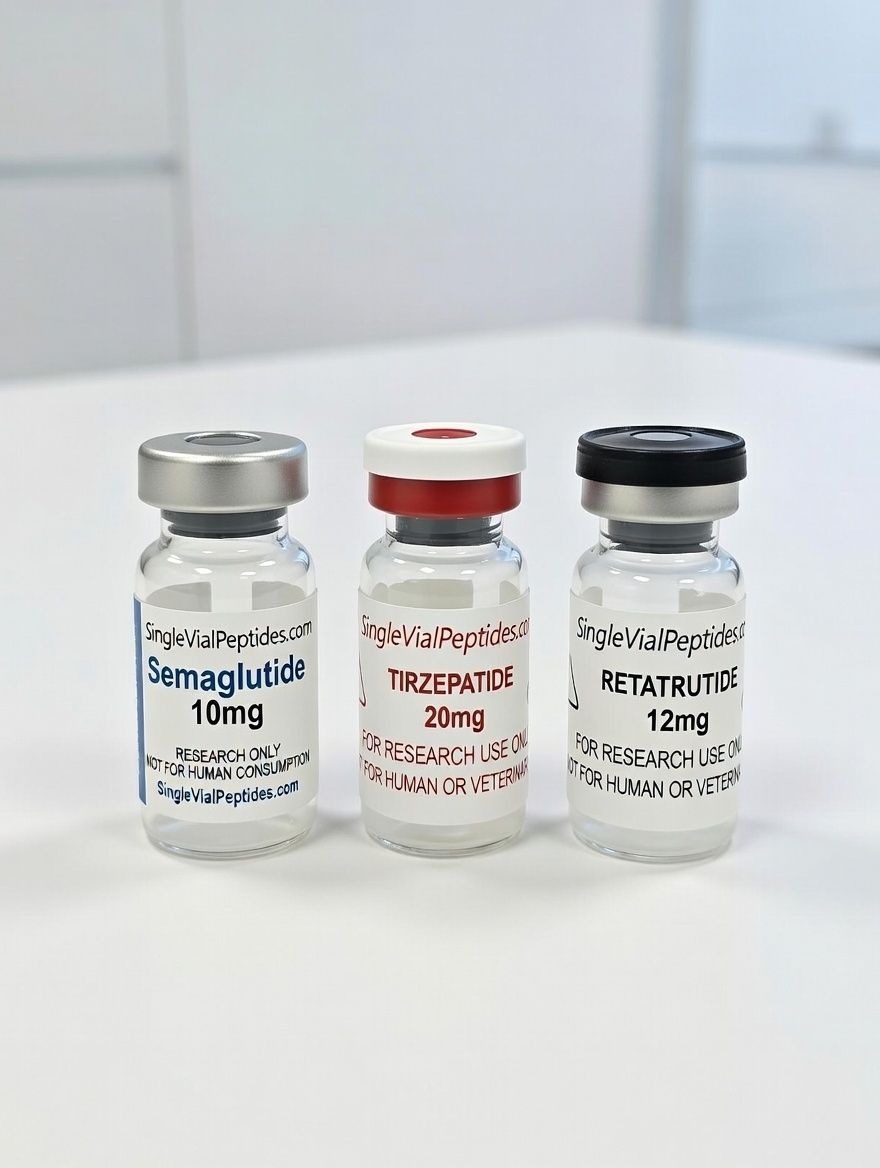
This shop sells research vials. The label says so. It does not sell a compounded prescription, and it does not describe a research vial as a med-spa medicine. Purity at least 99 percent. Fill within 10 percent of the labeled weight. Adults 21 and older. Not for people or animals.
Sources:
- FDA compounding policy, updated April 1, 2026
- FDA, April 30, 2026, 503B bulks proposal
- DiStefano et al., JAMA Health Forum, 2026
- Chetty et al., JAMA, July 6, 2026
- FDA, March 3, 2026, 30 warning letters
- FDA, retatrutide cannot be compounded
Injektionsflaskor för forskning. 21 eller äldre. Inte för människor eller djur. Inte medicinsk rådgivning.