 Single Vial Peptides
Brenipatide is the list. Eloralintide is the E.
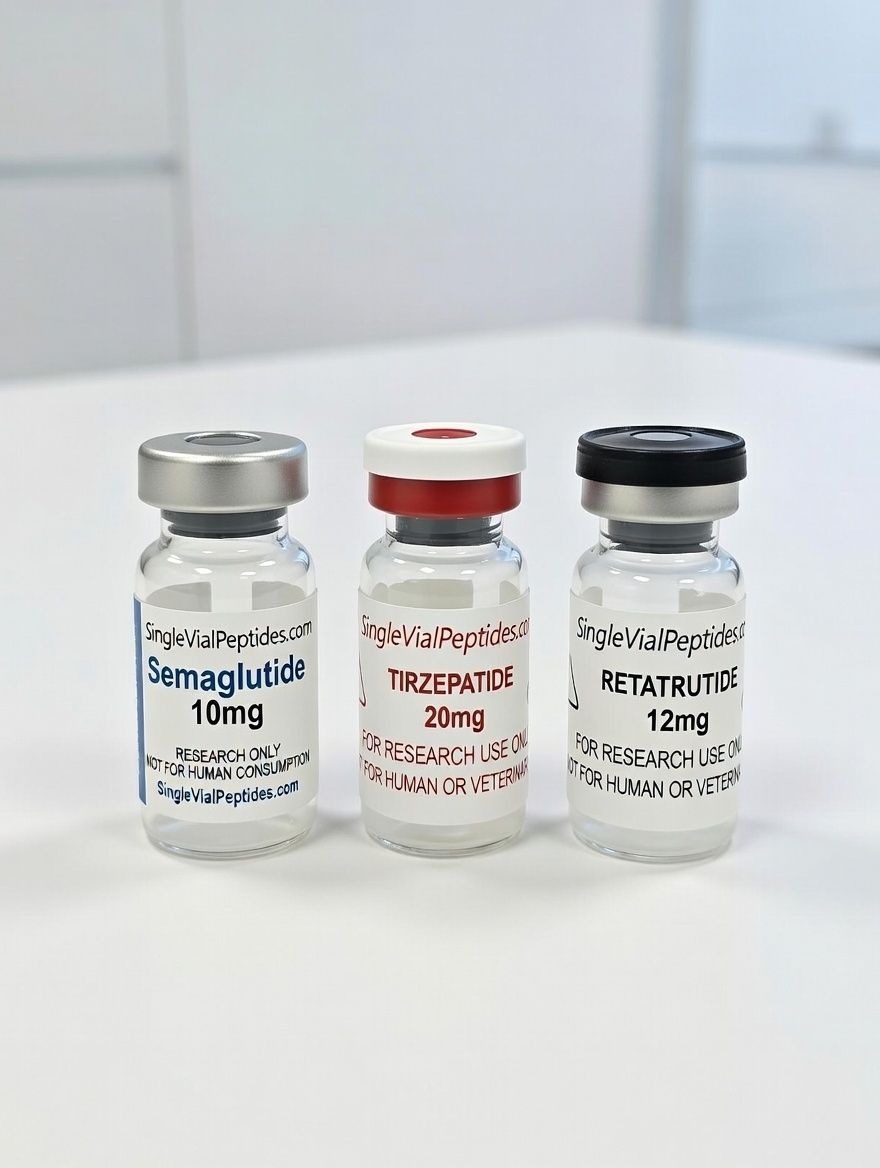
This shop does not sell brenipatide or eloralintide. Neither one is an FDA-approved drug. The vials here are research material, 21 and older, not for people or animals, and they are not a Lilly pen. Research use. What you are actually buying.
People have been mixing up two Lilly programs that both start with a vowel sound and neither of which you can buy as a brand. The long list, alcohol, smoking, opioids, mood, is the drug that starts with B. The drug that starts with E is a different chemical, aimed at weight and a shorter set of related conditions. Two names, one chemical is about brand names for a drug that already has an approval. This note is the opposite problem. Two study drugs, two mechanisms, and a letter that got swapped in conversation.
B is brenipatide. E is eloralintide.
Brenipatide is Lilly's long-acting dual GIP/GLP-1 receptor agonist. BioSpace, on September 22, 2026, introduced it as "a long-acting dual GIP/GLP-1 receptor agonist called brenipatide." Genetic Engineering News, on September 19, 2026, said it is "a dual-agonist of glucagon-like peptide-1 (GLP-1) and glucose-dependent insulinotropic polypeptide (GIP) receptors—the same modality as its blockbuster tirzepatide," and that unlike tirzepatide it "is designed to target GIP and GLP-1 receptors in central nervous system and inflammatory pathways that include receptors linked to reward and addiction in the brain." Designed and studied are the words on the page. The pages do not say it is approved for any of that.
Eloralintide is the other one. Lilly's own page, What to know about eloralintide, updated September 2026, says: "Eloralintide is an investigational once-weekly, injectable medication that is being studied for the treatment of obesity and other related cardiometabolic conditions. It belongs to a class of medicines called selective amylin receptor agonists." The same page says it "is designed to preferentially activate the amylin 1 receptor (AMY1R)." That is not a GIP/GLP-1 drug. It is not the smoking and mood list.
Lilly's trial records print the lab codes the news FAQ leaves off. On those records the brenipatide field reads "brenipatide / LY3537031." The eloralintide field reads "eloralintide / LY3841136 / AMY1176." The public "what to know" page does not print either LY code. The codes below are from the trial records, not from that FAQ.
What the outlets quote Nicholson as saying
Rob Nicholson is Lilly's, in BioSpace's wording, "associate vice president, US & Global Neuroscience Medical Affairs, Psychiatry & Substance Use Disorders." Psychiatric Times published a September 18, 2026 piece under his byline. He is describing studies. He is not describing a product on a shelf.
BioSpace says Lilly went to Phase 3 in two programs: RENEW-MDD-1, for major depressive disorder, looking at delaying the return of major depressive symptoms, and RENEW-ALC-1, for moderate-to-severe alcohol use disorder. The alcohol endpoint, as that page prints it, is a change in drinking patterns, not abstinence. BioSpace says topline results for those two are "expected in early 2028." Psychiatric Times, on the alcohol program, says Lilly's phase 3 program "includes 2 trials enrolling approximately 2,200 patients across 5 continents" and that "efficacy and safety results from the program are expected by mid-2028." Those are two different clocks on two different pages. This note does not pick one and erase the other.
Nicholson called the jump a "big bet." GEN reports that the Phase 3 trials were launched from Phase 1, not after a Phase 2 in those conditions, and quotes him on "why we thought it was worth going straight to Phase III in those conditions." He also told GEN that approved alcohol-use medicines "assume abstinence," while Lilly's trials look at "an overall change in drinking patterns."
The longer list is Phase 2, and it is still a list of studies. BioSpace and GEN both have Nicholson naming Phase 2 work in opioid use disorder, tobacco use disorder, bipolar disorder, and schizophrenia, plus immunology studies in asthma, irritable bowel syndrome, and COPD. Psychiatric Times names the same four Phase 2 brain and drug programs and does not, on the page that was opened, walk through the immunology set. Lilly trial records opened for this note include RENEW-ALC-1 (alcohol, Phase 3), RENEW-Smk-1 (a Phase 2 "Smoking Avoidance" record about reducing the risk of relapse to cigarettes in adults who recently quit), RENEW-Bipolar-1, RENEW-Op-1 (opioid use disorder, with buprenorphine), and RENEW-Scz-1 (schizophrenia, Phase 2, drug plus usual care versus placebo plus usual care). The schizophrenia record's own summary uses the phrase "for treatment of schizophrenia." That is the trial's purpose line. The record is still a Phase 2 study of an unapproved drug.
On the early safety read, BioSpace quotes Nicholson that side effects "in general were mild over the trial," and that "the likelihood of an individual having a GI side effect was comparable and equal between both those taking brenipatide and placebo." The page's numbers: gastrointestinal events in 25% of both the brenipatide arm and the placebo arm, dysesthesia-related events in 15.2% on brenipatide and none on placebo, four people stopping brenipatide because of side effects, and events in 57.6% of 184 people on the drug versus 42.9% of 28 on placebo. GEN reports no deaths and no serious adverse events in that early set, and a half-life "between 9.08 days and 12.5 days." BioSpace quotes the half-life as "between nine and 12 days," and quotes Nicholson that "in neurosciences we're looking at things from a weekly subcutaneous injection perspective." That sentence is him describing the trial plan. It is not instructions for anything sold here.
GEN also prints one sentence in which the drug name is spelled "benepatide." The rest of that article, and the other two outlets, spell it brenipatide. The quote is theirs, typo included. The chemical they are talking about is the B drug.
Eloralintide is the weight program, not the mood list
Lilly's September 2026 page says it "is developing eloralintide for the treatment of obesity and other obesity related conditions (such as obstructive sleep apnea and knee osteoarthritis pain)" and that it "is now conducting Phase 3 trials of eloralintide as a monotherapy" for those. The same page says Phase 2 results "were presented at ObesityWeek and simultaneously published in The Lancet in November 2025." The page names the paper, Billings and colleagues, November 6, 2025, and it does not print the weight-change percentages. This note does not fill that blank in from somewhere else.
The combination has its own name. Lilly says: "EloraTZP is Lilly's latest triple-acting investigational medicine combining eloralintide, a selective amylin receptor agonist, with tirzepatide, a dual GIP/GLP-1 receptor agonist. Lilly plans to advance EloraTZP into Phase 3 as a co-formulation." Read the word investigational. Where the page says "an approved dual GIP/GLP-1 receptor agonist," the word approved is attached to tirzepatide, the drug already on the market as Mounjaro and Zepbound, not to EloraTZP.
The page gives two clocks, and both stay. EloraTZP "has completed a Phase 2b trial" in adults with obesity, type 2 diabetes, and other obesity-related conditions, and Lilly "plans to initiate Phase 3 trials of EloraTZP as a co-formulation by the end of 2026." A nearby answer on the same page still describes the combination as being investigated "in Phase 2 trials." Completed Phase 2b, Phase 3 not started yet, is the reading that keeps both sentences. It is not "EloraTZP is already in Phase 3."
Lilly's trial pages for the monotherapy program are ENLIGHTEN-1 (obesity or overweight without type 2 diabetes), ENLIGHTEN-3 (moderate to severe obstructive sleep apnea, with obesity or overweight), and ENLIGHTEN-4 (knee osteoarthritis pain, with obesity or overweight). The records behind those pages list the drug as eloralintide / LY3841136 / AMY1176, Phase 3, randomized, placebo-controlled, status Open when they were pulled. Open means the study is open. It does not mean the drug is approved or for sale. ENLIGHTEN-4's short title is the knee-pain study. One field in that record still contains the literal words "Placeholder Title." The short title is the one the record actually uses for the knee study.
Retatrutide is still not approved either, and it is a third molecule, Lilly's GIP/GLP-1/glucagon agonist. It is not brenipatide and it is not eloralintide. What people mean by tirz, reta, and sema is about the names on this shop. Tirz on this shop is a research vial of tirzepatide, not Mounjaro, not Zepbound, and not EloraTZP. Tirz, reta, and sema are those vials. None of them is the B drug or the E drug.
Sources
- BioSpace, September 22, 2026, Heather McKenzie
- GEN, September 19, 2026, Alex Philippidis
- Psychiatric Times, September 18, 2026, Rob Nicholson
- Lilly, What to know about eloralintide, updated September 2026
- ENLIGHTEN-1, ENLIGHTEN-3, ENLIGHTEN-4
- Brenipatide trial records opened the same way: RENEW-ALC-1, RENEW-Smk-1, RENEW-Bipolar-1, RENEW-Op-1, RENEW-Scz-1
Research vials. 21 and older. Not for people or animals. Not a pharmacy. Not medical advice. Not brenipatide. Not eloralintide. Not a Lilly product.
Injektionsflaskor för forskning. 21 eller äldre. Inte för människor eller djur. Inte medicinsk rådgivning.