 Single Vial Peptides
Nobody has counted the bodybuilders
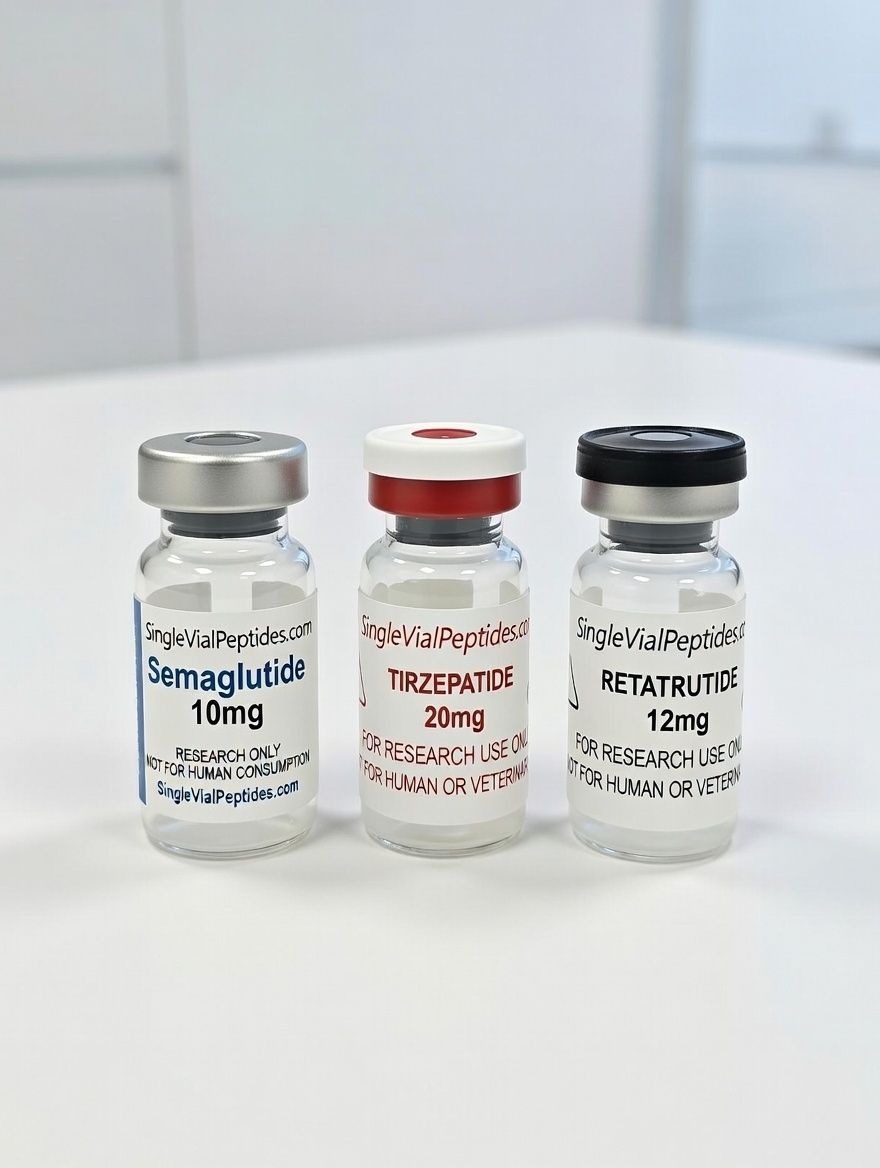
A lot of gym talk treats peptides as the default. One version of that talk says 99 percent of bodybuilders use them in some fashion. That number is a hunch. None of the pages opened for this note is a census of bodybuilders, and this shop is not going to promote a hunch into a fact.
What those pages do show is narrower, and more interesting. "Peptide" is a chemical word and a slang word, and they are not the same crowd.
The word covers insulin and a vial from a group chat
S. Bryn Austin, a professor at the Harvard T.H. Chan School of Public Health, told the school on October 1, 2026, that peptides are short chains of amino acids that can act like messengers. She names insulin as the familiar one, and semaglutide, sold as Ozempic and Wegovy, as the synthetic peptide in the headlines. Then she names a different pile: "Influencers are pushing out all sorts of dubious and often dangerous synthetic peptides, including BPC-157 and TB-500 (the so-called Wolverine Stack), MOTS-c, CJC-1295, ipamorelin, and others. They are marketed to speed recovery after a workout, heal sports injuries and wounds, and boost sports performance among other hyped-up claims."
That is the gym sentence. It is a marketing claim she is describing, not a result, and not a set of steps. The same answer says a vial bought online can say BPC-157 on the label while nobody has checked what else is in it. Her word for the answer is "Who knows?"
UCLA Health, October 9, 2026, quotes Thomas Kremen, a sports-medicine physician for the Los Angeles Chargers, the Los Angeles Lakers, USA Basketball, and the UCLA Bruins, and a former chair of USA Swimming's sports-medicine committee. "It's a lot of marketing and very little substance," he said. "The evidence that these peptides are effective is just not there."
Kremen and medical student Kushagra Tewari reviewed the literature on six names: BPC-157, TB-500, CJC-1295, MK-677, ipamorelin, and GHK-Cu. UCLA says the team analyzed 565 studies. Kremen says more than two-thirds were only in animals, with "promising but variable effects" on tendon, muscle, bone, and ligament healing in those animals, and "essentially no studies demonstrating significant clinical benefits for musculoskeletal conditions." Tewari says one of the biggest BPC-157 studies had a financial interest in the compound.
Kremen's bottom line on that page: "there is little to no evidence these peptide supplements work. And you don't know what's in them, so why take the risk?" He also says the marketing is "well ahead of the science."
Tested sport and the gym are not the same room
Tewari played college baseball. On the UCLA page he draws the line this note keeps running into. In that sport, "these substances were banned and athletes were continuously tested so they weren't used." What he sees now is "the general population, such as athletes who have stopped playing and recreational gym-goers. They're trying to bench-press or squat the maximum weight and may turn to untested performance-enhancing peptides to get that competitive edge. If they get injured, that's when they start looking at these other peptides marketed as injury recovery products."
That is a physician-in-training describing who asks. It is not a percentage of Olympia competitors, and it is not a percentage of people who lift.
The tested room has published rules and, sometimes, a name. On September 17, 2025, the U.S. Anti-Doping Agency said triathlon athlete Anthony McCauley, 46, of Raynham, Mass., accepted a four-year sanction. A whistleblower led USADA to evidence that he "possessed and used BPC-157 and TB-500," and that he promoted BPC-157, TB-500, CJC-1295, ipamorelin, and tesamorelin to followers, "some of whom were athletes subject to the World Anti-Doping Code." USADA called the promotion attempted complicity. His results from June 1, 2024, were disqualified. The ineligibility started September 9, 2025. USADA CEO Travis T. Tygart said the case was people in the sport "standing up to protect the culture of their sport."
McCauley is an age-group triathlete, not a bodybuilding champion. One sanction is not a prevalence. It is proof that, in a sport that adopted the WADA list, possession and promotion are enough. A positive lab test is not required for that kind of case. The ban clocks, class by class, are on Which peptides are banned where.
Natural bodybuilding wrote the ban in years, not in a vibe
The World Natural Bodybuilding Federation says athletes must be "a minimum of 10 years drug-free from all Anabolic Androgenic Agents, Peptides, HGH, Growth Hormones, and prescription/pharmaceutical hormones" on its banned list before a first WNBF competition. Its notice, dated from January 2022, says a failed urine or polygraph test for steroids, growth hormones, peptides, SARMs, or other oral or injectable performance drugs is a lifetime ban from WNBF membership privileges. The growth-hormone section says, in its own capitals, "UNLESS WADA STATES OTHERWISE – ALL HGH & SYNTHETIC PEPTIDES ARE BANNED FOR USE." The examples include BPC-157, CJC-1295, ipamorelin, sermorelin, GHRP-2, GHRP-6, and TB-500's neighborhood of growth factors. The WNBF also says it has "over 40,000 urine test results on file since 1989." That is a stack of tests. It is still not a percentage of all bodybuilders.
NPC natural contests, rules in force as of June 1, 2024, and still the natural-show page's 2026 qualification rule, prohibit "PEPTIDE HORMONES, GROWTH FACTORS" for 3 years before the contest. The footnote says that includes growth hormone, growth factors, and growth-factor modulators. Insulin used "for the purpose of bodybuilding" is also 3 years. Prescribed insulin is permitted. "Insulin manipulators," when used solely for weight loss, are 6 months, and the examples on that page are Wegovy, Ozempic, Metformin, and Rybelsus. Open shows that do not use this natural rulebook were not opened for this note. This page does not invent a policy for them.
Austin's Harvard answer adds one more tested group in a sentence: "Competitive athletes, service members, and others who are required to undergo drug testing for their jobs need to be on high alert" about synthetic peptides sold online or by wellness retailers and medical spas, because a failed test can mean being barred or fired.
What this shop is selling in the middle of that noise
The nicknames on the vials here are the nicknames in those quotes. Wolverine on this shop is one vial, 10mg BPC-157 and 10mg TB-500. The longer label note is Wolverine, GLOW, and KLOW. What CNN, Scientific American, and the other outlets printed is already quoted. None of that is a training plan.
A research vial is not a WNBF clearance, an NPC polygraph answer, or a WADA therapeutic-use exemption. Adults 21 and older. Laboratory research only. Not for people or animals. Not a pharmacy. Not medical advice. At least 99 percent pure. Fill within 10 percent of the label.
Research vials. 21 and older. Not for people or animals. Not medical advice.