 Single Vial Peptides
What papers say about TB-500
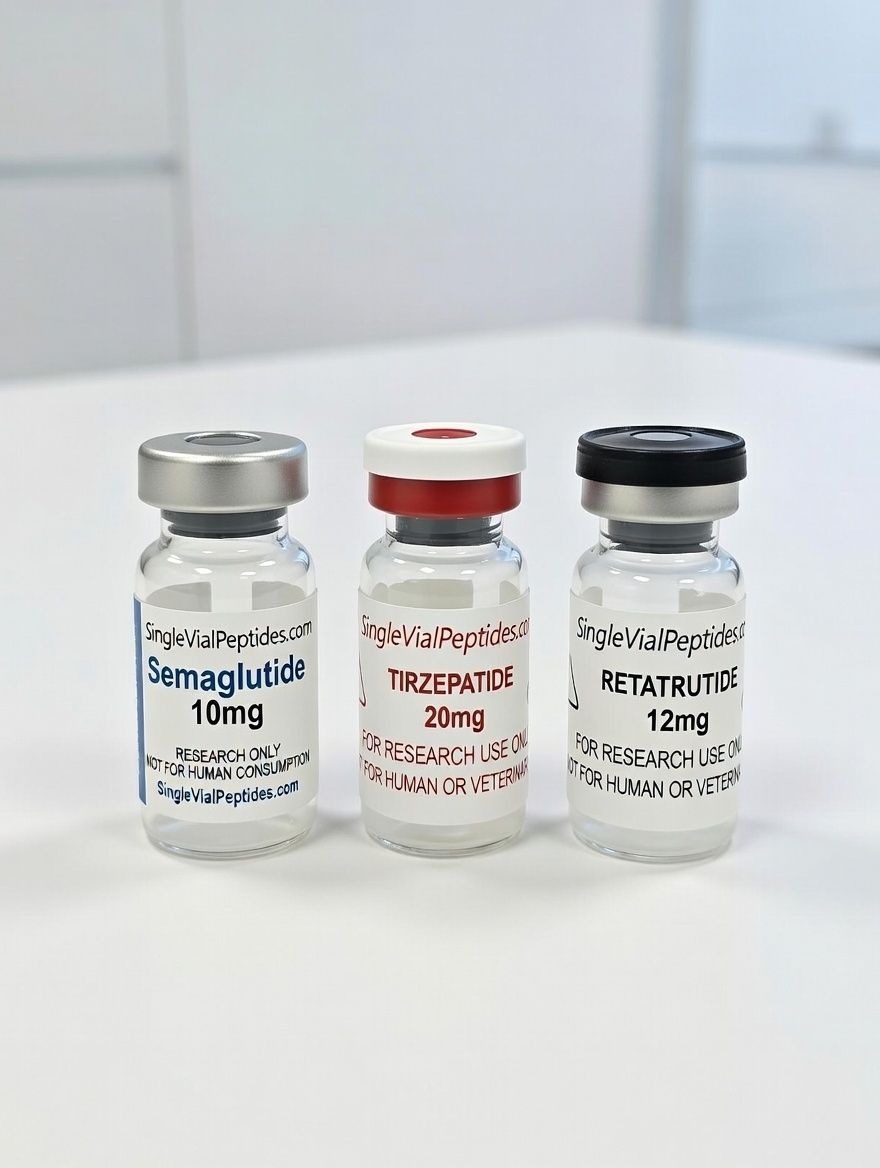
TB-500 and thymosin beta-4 are not two names for one molecule in the sources opened here. The analytical papers define a short fragment. A separate paper describes the longer protein. FDA treats the common name TB-500 as its own bulk substance and says it is not a component of an approved drug. A vial from this shop is not the material in any of those studies.
TB-500 as a fragment in the analytical papers
Simone Esposito and colleagues, in Drug Testing and Analysis, wrote about a product called TB-500. The abstract says the formulation "is suspected to be used as doping agent in sport," and then states what they identified:
"This work describes the detection and the identification of the N-terminal acetylated 17-23 fragment of human thymosin beta 4 (Ac-LKKTETQ) in TB-500 by means of high-performance liquid chromatography/high resolution mass spectrometry."
They add that Ac-LKKTETQ "was also synthesized by solid-phase peptide synthesis." The sequence is seven residues, positions 17 through 23 of human thymosin beta-4, acetylated at the N-terminus. That identifies a fragment in a product the authors called TB-500. It does not define the full protein or this shop's vial.
Emmie N. M. Ho and colleagues, in the Journal of Chromatography A, describe the preparation from a racing laboratory. The abstract says:
"A veterinary preparation known as TB-500 and containing a synthetic version of the naturally occurring peptide LKKTETQ has emerged. The peptide segment (17)LKKTETQ(23) is the active site within the protein thymosin β(4) responsible for actin binding, cell migration and wound healing. The key ingredient of TB-500 is the peptide LKKTETQ with artificial acetylation of the N-terminus."
The middle sentence is the authors' claim about that segment inside the parent protein. This shop does not adopt it. The last sentence is the chemical point: they assign TB-500 to LKKTETQ with an artificial acetyl group. The paper is a horse detection method, not a treatment study.
One result from horses, labeled as detection
The Ho abstract reports administration to horses:
"This method was successful in confirming the presence of N-acetylated LKKTETQ and its metabolites in equine urine and plasma collected from horses administered with a single dose of TB-500 (containing 10mg of N-acetylated LKKTETQ)."
That sentence is a detection result in horses, not a healing measurement and not a result in people. The amount inside the quotation is the paper's figure. It is not a dose for a person, and this note does not convert it.
Thymosin beta-4 is the longer peptide
Gerald Sosne and Elizabeth A. Berger, in International Immunopharmacology in 2023, call thymosin beta-4 "a small, naturally occurring 43-amino-acid protein" and write that it was "currently in Phase 3 human clinical trials for dry eye disease." Those words are about the 43-residue protein. They are not a description of Ac-LKKTETQ, and a phase named by authors is not an FDA approval.
On the World Anti-Doping Agency Prohibited List page, section S2.3 includes "Thymosin-β4 and its derivatives e.g. TB-500," prohibited at all times. The example is filed as a derivative, not as a synonym for the full protein. BPC-157 appears on that page under a different class, S0.
What FDA wrote about TB-500
FDA's briefing for the July 23–24, 2026 meeting is titled "TB-500-Related Bulk Drug Substances (TB-500 (Free Base) and TB-500 acetate)." It says:
"TB-500 (free base) is understood today to be a seven amino acid synthetic fragment of thymosin beta-4 (β4) from amino acids 17 to 23 and an acetyl group at the N-terminal leucine amino acid (Ac-Leu-Lys-Lys-Thr-Glu-Thr-Gln-OH)."
FDA lists the formula C38H68N10O14 and a molecular weight of 889.01 g/mol for that reported free base. It says "TB-500 is a common name and not a United States Adopted Name (USAN)," and that multiple salts and derivatives have been sold under that name. The free base and the acetate are different active pharmaceutical ingredients. A label that says only "TB-500" does not say which one is meant.
On category, the briefing says: "There is no applicable United States Pharmacopeia (USP) or National Formulary (NF) drug substance monograph for TB-500 (free base) or its acetate form, and neither is a component of an FDA-approved drug."
FDA evaluated the nominated use of wound healing and found "a lack of evidence to evaluate the effectiveness" of either form. It "did not find any information in the medical literature where, TB-500 was administered to patients to treat any disease or condition including its use in wound healing."
FDA says the nominator also submitted articles on the non-acetylated heptapeptide LKKTETQ. Those are a different substance. FDA "did not identify nonclinical in-vivo pharmacological studies assessing the potential for TB-500 (free base) or TB-500 acetate to promote wound healing," and it reports an in-vitro fibroblast study in which TB-500 (free base) did not induce wound healing across a scratch. Its summary: "nonclinical pharmacological evidence is currently lacking to support the potential for TB-500 to promote wound healing." Studies of the 43-residue protein are not studies of that acetylated fragment.
The recommendation says the criteria "weigh against their being added to the 503A Bulks List," and "we propose not adding TB-500 (free base) or TB-500 acetate to the 503A Bulks List." The cover sheet says a final determination would wait on the advisory-committee process. This note does not report a vote. No vote record was opened.
The Federal Register notice
The Federal Register notice of April 16, 2026, says that on July 23, 2026, the committee would discuss "TB-500 (free base)/TB-500 acetate" for the 503A Bulks List. It restates the three routes under section 503A: an applicable monograph, status as a component of an approved drug, or a place on the list issued by regulation. The notice schedules a discussion. It does not add TB-500 to the list.
The TB-500 vial this shop sells
This shop sells a TB-500 5 mg research vial for $35, or two for $60, at singlevialpeptides.com/vial/tb-500-5mg. Purity is at least 99 percent. Fill is within 10 percent of the labeled weight. Buyers must be 21 or older. It is not for people or animals. This shop is not a pharmacy, and this page is not medical advice.
The listing uses the name and a milligram weight. It does not say the vial is the batch in the Esposito paper, the preparation in the Ho paper, or the 43-amino-acid protein Sosne and Berger discussed. BPC-157 is a different peptide. A vial that prints both names is a blend label, not a new substance those papers defined.
The July 2026 vote is quoted on its own page
MedPage and Pharmacy Times printed the committee tallies. Those tallies, and the lines saying a recommendation is not an approval, are in The July 2026 peptide vote is not an FDA approval. This page does not turn that vote into a shop claim.
What CNN and the other outlets wrote
The news quotes are collected in What CNN, Fox, and the other outlets wrote. On TB-500, Reuters calls it the second peptide in the "Wolverine stack" with BPC-157. Reuters. CNN and Fox print the July docket's proposed use as wound healing. CNN's tally for the TB-500 forms it covered is 8-6 with one abstention. CNN. Fox News. The Guardian, April 4, 2026, says reviewers found "human data around musculoskeletal conditions are lacking" and "there had been no studies of TB-500 in human participants." The Guardian. Scientific American says TB-500 "is supposed to promote healing but has even less research behind it." Scientific American. Those are the outlets' sentences.
Sources
- Esposito and colleagues, Drug Testing and Analysis. https://pubmed.ncbi.nlm.nih.gov/22962027/
- Ho and colleagues, Journal of Chromatography A. https://pubmed.ncbi.nlm.nih.gov/23084823/
- Sosne and Berger, International Immunopharmacology, 2023. https://pubmed.ncbi.nlm.nih.gov/37018981/
- FDA briefing, TB-500-related bulk drug substances, July 23–24, 2026 meeting. https://www.fda.gov/media/193349/download
- Federal Register, April 16, 2026, 91 FR 20465. https://www.govinfo.gov/content/pkg/FR-2026-04-16/pdf/2026-07361.pdf
- World Anti-Doping Agency, Prohibited List. https://www.wada-ama.org/en/prohibited-list
- Shop listing: https://singlevialpeptides.com/vial/tb-500-5mg
Research vials. 21 and older. Not for people or animals.
Viales de investigación. 21 años o más. No es para personas ni animales. No es consejo médico.