 Single Vial Peptides
GLOW and KLOW are blends
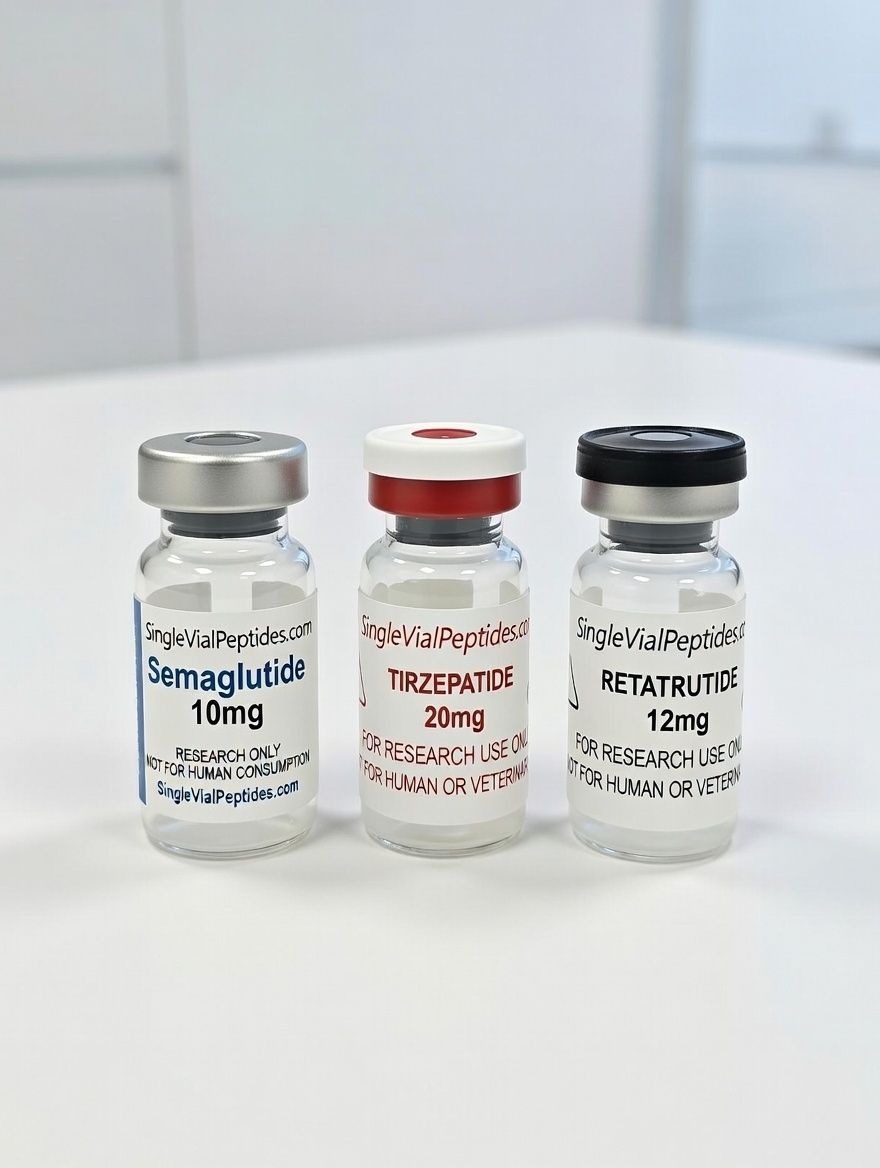
People search "GLOW peptide" and "KLOW peptide" as if each name were one molecule. It is not. GLOW and KLOW are nicknames for blends in one vial. A blend is several peptides sharing a container. The nickname does not create a new sequence, and a paper about one ingredient is not a paper about the mixture.
This shop does not claim what the blend does. Where a paper is quoted below, the quote is about that ingredient, in that paper's experiment. Mouse and rat work is labeled as that paper's animal experiment. This note is not a protocol.
The GLOW peptide name is three labels in one vial
GLOW 70mg is one vial labeled GHK-Cu 50mg, BPC-157 10mg, and TB-500 10mg. Fifty plus ten plus ten is seventy. The 70mg is that sum of labeled milligrams, not a new compound. The price is $80. Purity is at least 99 percent. Fill is within 10 percent of the label. By the label, GHK-Cu is most of the mass. That is label arithmetic, not an assay reprinted here.
The three names are also sold apart: GHK-Cu, BPC-157, and TB-500. Buying them in one vial is a packaging choice. It does not make them one chemical.
The KLOW peptide name adds one more peptide
KLOW 80mg is the GLOW blend plus KPV 10mg. The label is GHK-Cu 50mg, BPC-157 10mg, TB-500 10mg, and KPV 10mg. Those four labeled amounts add to 80mg. The price is $85. The same purity and fill rule applies: at least 99 percent pure, fill within 10 percent of the label.
KLOW is not a longer version of one chain. It is GLOW's three names plus a fourth peptide, KPV, in the same vial. KPV alone is its own 10mg vial.
One GLOW vial and one KLOW vial together are $150. That bundle price is the price in this shop's catalog.
What PubMed returned for the nicknames
Two searches were opened on PubMed while this note was written.
A search for the quoted phrases "GLOW peptide," "KLOW peptide," and "GLOW blend," together with GHK, returned no results. That search.
A second search, the quoted word "KLOW" plus peptide, returned seven papers. None on that page was a peptide named KLOW. The hits included authors named Kløw, and a 1994 paper that uses "Klow" for a low-affinity state of a dopamine receptor. That search.
An empty phrase search is not proof that no manuscript mentions a mixture. It is what those two pages returned. No page opened for this note defines GLOW or KLOW as one sequence, or reports an experiment on either nickname.
Papers name the parts, not the blend
GHK-Cu. Pickart and Margolina, International Journal of Molecular Sciences, 2018, call it a small copper-binding tripeptide, glycyl-L-histidyl-L-lysine, present in human plasma. Maquart and colleagues, FEBS Letters, 1988, report that GHK-Cu stimulated collagen synthesis by fibroblasts. In that abstract the effect began between 10(-12) and 10(-11) M and was greatest at 10(-9) M, with no change in cell number. Those are culture concentrations, not a dose. The 2018 review also summarizes topical creams and animal wound experiments in rabbits and rats. That work is about GHK-Cu, not about a vial that also holds other peptides. GHK-Cu 50mg is $35, two for $60, or five for $120.
KPV. Dalmasso and colleagues, Gastroenterology, 2008, write that KPV is Lys-Pro-Val, "the C-terminal sequence of α-melanocyte stimulating hormone (α-MSH)." Luger and Brzoska, Annals of the Rheumatic Diseases, 2007, call alpha-MSH a thirteen-amino-acid tridecapeptide and write that most of its anti-inflammatory activity "can be attributed to its C-terminal tripeptide KPV." In Dalmasso's human cell lines, nanomolar KPV reduced NF-κB and MAP kinase signaling, and they concluded the effect was PepT1-mediated rather than melanocortin-receptor-mediated. In that paper's mouse experiments, oral KPV reduced DSS-induced and TNBS-induced colitis. Those mouse experiments are not a schedule, and they are not a result for a four-peptide blend. KPV 10mg is $40.
BPC-157. Staresinic and colleagues, Biomedicines, 2022, call it the stable gastric pentadecapeptide and print the structure GEPPPGKPADDAGLV. They write that it is "native to and stable in human gastric juice, even for periods of time longer than 24 h." The abstract frames muscle and tendon findings as effective "in rat injury." That is rat work in that paper. The review lists many conditions. This note does not move that list onto BPC-157 as sold here, and it does not move it onto GLOW. The separate vial is BPC-157.
TB-500. Our label says TB-500. Xing and colleagues, Frontiers in Endocrinology, 2021, review thymosin β4 and never use the name TB-500. They write that thymosin β4 "comprises 43 amino acids," and that "the active fragment encoded by amino acids 17–23 triggers angiogenesis and growth of hair follicles," in the studies they cite. Because that page does not identify the fragment or the 43-residue peptide as TB-500, this note does not treat the label and that protein as the same substance. Examples in the review include animal experiments: pretreated cells transplanted into an infarcted rat heart, and hindlimb ischemia in mice. Those are animal experiments about thymosin β4. They are not blend results. The separate vial is TB-500.
A shared vial is not a shared result
None of the pages opened here studied those peptides together under the name GLOW or KLOW. Sharing a vial does not add the papers together, and it does not create a GLOW peptide or a KLOW peptide in the chemical sense. The useful question is which peptides the label lists, and in what labeled amounts. On this shop the amounts are the ones above.
Sale is to adults 21 and older. The vials are research material. They are not for people or animals. This shop is not a pharmacy. This page is not medical advice. It does not describe mixing, drawing, or a dose.
The July 2026 vote is quoted on its own page
MedPage and Pharmacy Times printed the committee tallies. Those tallies, and the lines saying a recommendation is not an approval, are in The July 2026 peptide vote is not an FDA approval. This page does not turn that vote into a shop claim.
What CNN and the other outlets wrote
Scientific American, April 18, 2026, is the major piece opened for this note that defines the blend nicknames. Bethany Brookshire writes that adding GHK-Cu and KPV to the Wolverine pair is what people call "glow" or "KLOW," and that "People claim that GHK-Cu increases wound healing, decreases scarring and helps regenerate collagen" and that KPV "reduces inflammation." Scientific American. Reuters and The Guardian define Wolverine as BPC-157 plus TB-500 and do not define GLOW or KLOW. The quotations are gathered in What CNN, Fox, and the other outlets wrote and on Wolverine, GLOW, and KLOW. A claim in a magazine is not a trial of the blend.
Sources
- Pickart L, Margolina A. Regenerative and Protective Actions of the GHK-Cu Peptide in the Light of the New Gene Data. International Journal of Molecular Sciences, 2018. Full text
- Maquart FX, et al. Stimulation of collagen synthesis in fibroblast cultures by the tripeptide-copper complex glycyl-L-histidyl-L-lysine-Cu2+. FEBS Letters, 1988. PubMed abstract
- Dalmasso G, et al. PepT1-Mediated Tripeptide KPV Uptake Reduces Intestinal Inflammation. Gastroenterology, 2008. Full text
- Luger TA, Brzoska T. α-MSH related peptides: a new class of anti-inflammatory and immunomodulating drugs. Annals of the Rheumatic Diseases, 2007. Full text
- Staresinic M, et al. Stable Gastric Pentadecapeptide BPC 157 and Striated, Smooth, and Heart Muscle. Biomedicines, 2022. Full text
- Xing Y, Ye Y, Zuo H, Li Y. Progress on the Function and Application of Thymosin β4. Frontiers in Endocrinology, 2021. Full text
- PubMed search, quoted phrases "GLOW peptide," "KLOW peptide," and "GLOW blend," plus GHK. No results
- PubMed search, quoted "KLOW" plus peptide. Seven unrelated hits
Research vials. 21 and older. Not for people or animals.
Viales de investigación. 21 años o más. No es para personas ni animales. No es consejo médico.