 Single Vial Peptides
Wolverine is two peptides in one vial
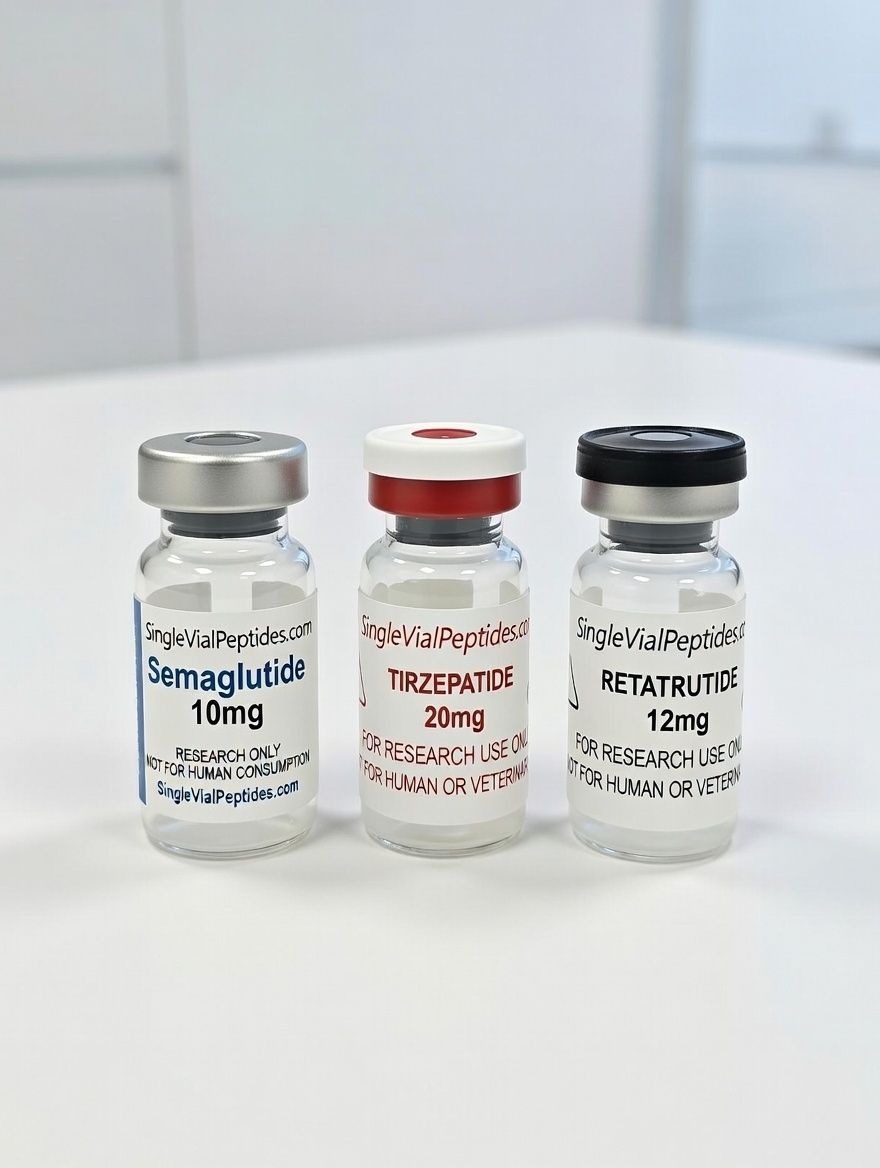
Wolverine peptide is a marketplace nickname, not a molecule. A PubMed search for the quoted phrase "wolverine peptide" returned no records. A search combining wolverine, peptide, and BPC also returned none. There was no indexed paper under that name to quote, and this page will not invent one.
On this shop's label, the nickname points to two peptides in one vial. Wolverine is one vial labeled BPC-157 10 mg plus TB-500 10 mg, sold for $75, at singlevialpeptides.com/vial/wolverine-10mg. The same names are sold apart: BPC-157 5 mg at $35, or two for $60, and TB-500 5 mg at $35, or two for $60. Purity is at least 99 percent. Fill is within 10 percent of the labeled weight. Buyers must be 21 or older. The material is not for people or animals. This shop is not a pharmacy, and this page is not medical advice.
Two names on one label do not create a third chemical. The quotations below are about BPC-157, TB-500, or thymosin beta-4. None of them names Wolverine, and none of them used this shop's vial.
BPC-157, quoted from a review and from FDA
Sikiric and colleagues, in a 2011 review in Current Pharmaceutical Design, call the first name a pentadecapeptide and print a sequence. The abstract says: "Stable gastric pentadecapeptide BPC 157 is an anti-ulcer peptidergic agent, safe in inflammatory bowel disease clinical trials (GEPPPGKPADDAGLV, M.W. 1419, PL 14736) and wound healing, stable in human gastric juice and has no reported toxicity." The sequence in parentheses is fifteen residues. The words "safe" and "no reported toxicity" belong to the authors. This shop does not adopt them. The same abstract's rat sentence says: "In rat esophagitis and failed function of both lower esophageal sphincter (LES) and pyloric sphincters (PS), BPC 157 increased pressure in both sphincters till normal and reduced esophagitis." That is a rat experiment in the review, not a human result and not a result for a blend.
FDA's 2026 briefing on BPC-157-related bulk drug substances says "BPC-157 is also known as Bepecin or PL-14736, which is a peptide that is reported to be comprised of 15 amino acids." The chemistry section says the free base "is reported to be a pentadecapeptide fragment of BPC (H-Gly-Glu-Pro-Pro-Pro-Gly-Lys-Pro-Ala-Asp-Asp-Ala-Gly-Leu-Val-OH) that has been found in gastric juice," with formula C62H98N16O22 and a molecular weight of 1419.5 g/mol. FDA says the free base and the acetate "are different active pharmaceutical ingredients."
On category, FDA writes: "There is no applicable United States Pharmacopeia (USP) or National Formulary (NF) drug substance monograph for BPC-157 (free base) or its acetate form, and neither is a component of an FDA-approved drug." FDA evaluated both for ulcerative colitis and found "a lack of evidence to support the effectiveness" of either for that disease. The briefing proposes "not adding BPC-157 (free base) or BPC-157 acetate to the 503A Bulks List."
TB-500 and thymosin beta-4, quoted separately
Esposito and colleagues wrote that they identified, in a product called TB-500, "the N-terminal acetylated 17-23 fragment of human thymosin beta 4 (Ac-LKKTETQ)." Ho and colleagues describe "a veterinary preparation known as TB-500 and containing a synthetic version of the naturally occurring peptide LKKTETQ," and say "the key ingredient of TB-500 is the peptide LKKTETQ with artificial acetylation of the N-terminus." Both papers are about a seven-residue fragment, not about a blend with BPC-157.
Ho's result is detection in horses, not healing. The method confirmed "the presence of N-acetylated LKKTETQ and its metabolites in equine urine and plasma collected from horses administered with a single dose of TB-500 (containing 10mg of N-acetylated LKKTETQ)." That 10 mg figure is the authors' description of a horse preparation. It is not a dose for a person, and it is not the labeled fill on this shop's vial.
Thymosin beta-4 is the longer peptide. Sosne and Berger, in 2023, call it "a small, naturally occurring 43-amino-acid protein" and say it was then in Phase 3 trials for dry eye disease. A phase is not an approval. The 43-residue protein is not Ac-LKKTETQ, and it is not a vial that also contains BPC-157.
FDA's TB-500 briefing uses the same fragment: "TB-500 (free base) is understood today to be a seven amino acid synthetic fragment of thymosin beta-4 (β4) from amino acids 17 to 23 and an acetyl group at the N-terminal leucine amino acid (Ac-Leu-Lys-Lys-Thr-Glu-Thr-Gln-OH)." FDA says TB-500 "is a common name and not a United States Adopted Name," and that the free base and the acetate are different substances. Neither "is a component of an FDA-approved drug," and no applicable monograph applied.
FDA evaluated TB-500 for wound healing and did not find literature in which "TB-500 was administered to patients to treat any disease or condition including its use in wound healing." It also did not identify nonclinical in-vivo studies of the free base or the acetate for that use, and called the evidence "currently lacking." Papers on the non-acetylated fragment LKKTETQ are not studies of acetylated TB-500, and they are not studies of a blend. FDA proposed "not adding TB-500 (free base) or TB-500 acetate to the 503A Bulks List."
Why Wolverine peptide is still two names
The April 16, 2026 Federal Register notice put BPC-157-related substances and TB-500-related substances on the same July 23, 2026 agenda as separate items for the 503A Bulks List. Under section 503A, a bulk substance needs an applicable monograph, or it must be a component of an approved drug, or it must appear on the list issued by regulation. Sharing a meeting does not fuse two chemicals. FDA wrote a separate briefing for each.
The World Anti-Doping Agency Prohibited List page files them apart. BPC-157 is under S0, Non-approved substances, prohibited at all times. "Thymosin-β4 and its derivatives e.g. TB-500" are under S2.3, also prohibited at all times. A nickname does not move either line.
FDA's BPC-157 briefing notes that some websites sell BPC-157 together with a thymosin beta-4 fragment described as TB-500. That is a description of catalogs, not a study, not an approval, and not a description of this shop's vial. No experiment cited here used that vial. This note does not report a committee vote, because no vote record was opened.
The July 2026 vote is quoted on its own page
MedPage and Pharmacy Times printed the committee tallies. Those tallies, and the lines saying a recommendation is not an approval, are in The July 2026 peptide vote is not an FDA approval. This page does not turn that vote into a shop claim.
What CNN and the other outlets wrote
Reuters, The Guardian, Scientific American, The Verge, and NewsNation define the Wolverine name as BPC-157 plus TB-500. The quotations, and the separate GLOW and KLOW lines, are in Wolverine, GLOW, and KLOW and in What CNN, Fox, and the other outlets wrote. Reuters says the social-media claims of muscle growth and injury recovery are "not backed by scientific testing." That sentence stays Reuters' sentence.
Sources
- PubMed search for "wolverine peptide," which returned no records, and a combined search for wolverine, peptide, and BPC, which also returned none. https://pubmed.ncbi.nlm.nih.gov/?term=%22wolverine+peptide%22
- Sikiric and colleagues, Current Pharmaceutical Design, 2011. https://pubmed.ncbi.nlm.nih.gov/21548867/
- Esposito and colleagues, Drug Testing and Analysis. https://pubmed.ncbi.nlm.nih.gov/22962027/
- Ho and colleagues, Journal of Chromatography A. https://pubmed.ncbi.nlm.nih.gov/23084823/
- Sosne and Berger, International Immunopharmacology, 2023. https://pubmed.ncbi.nlm.nih.gov/37018981/
- FDA briefing on BPC-157-related bulk drug substances. https://www.fda.gov/media/193343/download
- FDA briefing on TB-500-related bulk drug substances. https://www.fda.gov/media/193349/download
- Federal Register, April 16, 2026, 91 FR 20465. https://www.govinfo.gov/content/pkg/FR-2026-04-16/pdf/2026-07361.pdf
- World Anti-Doping Agency, Prohibited List. https://www.wada-ama.org/en/prohibited-list
- Shop listings: https://singlevialpeptides.com/vial/wolverine-10mg and https://singlevialpeptides.com/vial/bpc-5mg and https://singlevialpeptides.com/vial/tb-500-5mg
Research vials. 21 and older. Not for people or animals.
Frascos de pesquisa. 21 anos ou mais. Não é para pessoas nem animais. Não é orientação médica.