 Single Vial Peptides
MOTS-c, in the words of the papers
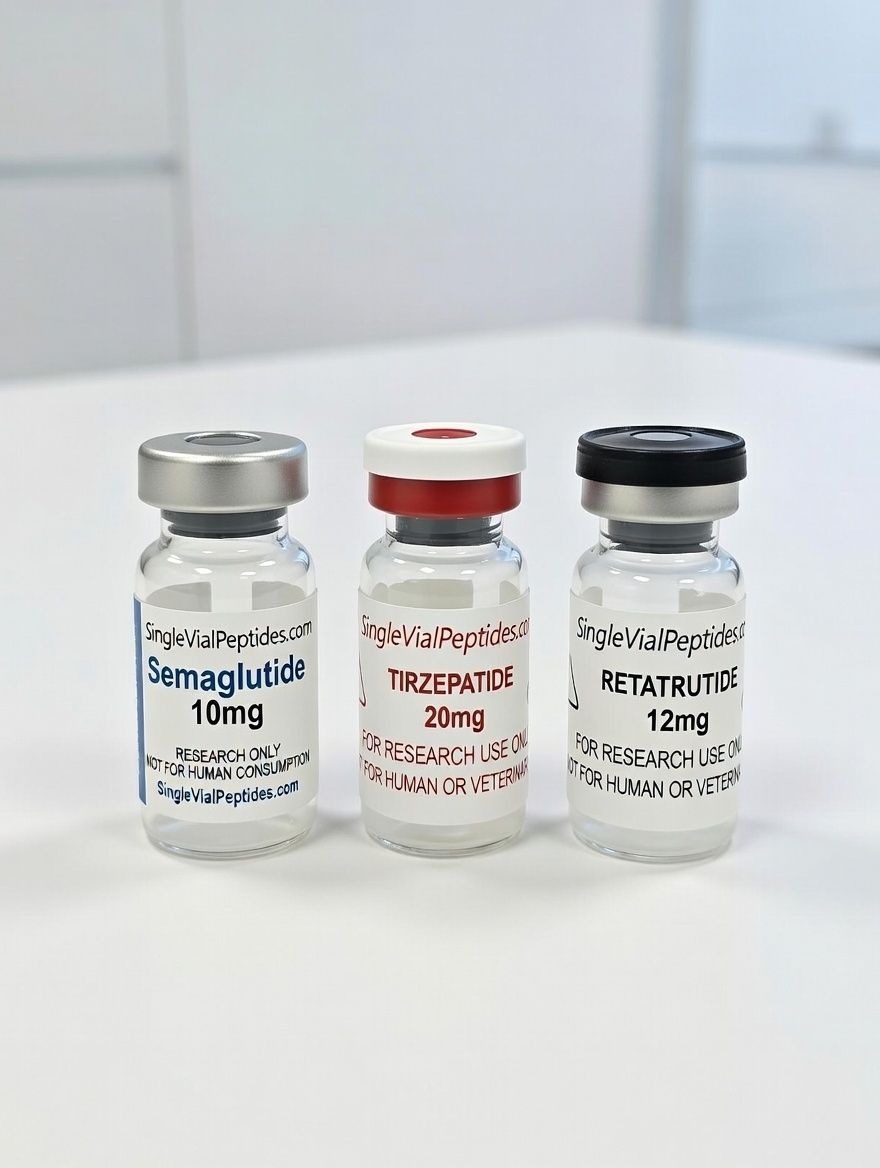
MOTS-c 10mg is $35 in the catalog. Three vials are $100. The path is MOTS-c 10mg. The vial is research material, at least 99 percent pure, with fill within 10 percent of the 10mg label. Buyers are 21 and older. It is not for people or animals. This shop is not a pharmacy, and this page is not medical advice.
A shorter note, without these quotations, is MOTS-c, in normal words. This page is the quotation version. It does not turn either paper into a protocol.
MOTS-c, as Lee et al. named it in 2015
Lee and colleagues published "The mitochondrial-derived peptide MOTS-c promotes metabolic homeostasis and reduces obesity and insulin resistance" in Cell Metabolism in 2015. The PubMed record gives the name in their words: "a sORF within the mitochondrial 12S rRNA encoding a 16-amino-acid peptide named MOTS-c (mitochondrial open reading frame of the 12S rRNA-c)."
The same abstract states the result this way: "MOTS-c treatment in mice prevented age-dependent and high-fat-diet-induced insulin resistance, as well as diet-induced obesity." That is a mouse experiment. The abstract also says: "Its primary target organ appears to be the skeletal muscle, and its cellular actions inhibit the folate cycle and its tethered de novo purine biosynthesis, leading to AMPK activation." That sentence is in the same mouse paper. Lee et al. close with: "These results suggest that mitochondria may actively regulate metabolic homeostasis at the cellular and organismal level via peptides encoded within their genome." The suggestion is theirs. It is not a claim this shop is making on its own, and it is not a schedule.
The shorter note already says a mouse paper is not a schedule for a person. Nothing below changes that.
What Reynolds et al. reported in mice in 2021
Reynolds and colleagues published "MOTS-c is an exercise-induced mitochondrial-encoded regulator of age-dependent physical decline and muscle homeostasis" in Nature Communications on January 20, 2021. The abstract says: "Here, we report that mitochondrial-encoded MOTS-c can significantly enhance physical performance in young (2 mo.), middle-age (12 mo.), and old (22 mo.) mice." Those ages are ages of mice. That sentence is a mouse experiment.
The abstract also says MOTS-c can regulate nuclear genes related to metabolism and proteostasis, skeletal muscle metabolism, and myoblast adaptation to metabolic stress. Those clauses sit in the same paper as the mouse performance claim. The abstract then says: "We provide evidence that late-life (23.5 mo.) initiated intermittent MOTS-c treatment (3x/week) can increase physical capacity and healthspan in mice." The parenthetical is the authors' description of a mouse experiment. This page does not convert that mouse schedule into a human protocol.
In the results, Reynolds et al. wrote that both middle-aged and old mice ran significantly longer, with increased power output, following MOTS-c treatment. They wrote that old mice ran longer (2-fold) and farther (2.16-fold) when treated with MOTS-c. Those folds are their mouse experiment. They also wrote that 17 percent of the old mice reached the final running stage, and that none of the untreated old mice did. That comparison is a mouse experiment.
On a later test in old mice, they wrote that the late-life intermittent treatment improved grip strength, gait assessed by stride length, and physical performance on a 60-second walking test, and that these data indicate the treatment improved physical capacity in old mice. Mouse experiment. On lifespan, the figure legend does not declare a clear extension. It says the curve had P = 0.05 until 31.8 months of age, and that the overall curve trended toward increased median and maximum lifespan (P = 0.23). That trend is the paper's report in mice. This note does not turn it into a promise.
One abstract sentence is not a treatment result. Reynolds et al. wrote: "In humans, exercise induces endogenous MOTS-c expression in skeletal muscle and in circulation." The results describe young male volunteers on a stationary bicycle. Relative MOTS-c in muscle rose after exercise (11.9-fold on their Western blot). Circulating endogenous MOTS-c rose during and after exercise (1.6-fold and 1.5-fold on their ELISA). That is the paper measuring the volunteers' own peptide after exercise. It is not a study of giving people MOTS-c, and it is not a result for this vial.
What FDA wrote about MOTS-c
FDA's briefing for the Pharmacy Compounding Advisory Committee meeting of July 23–24, 2026, carries the date May 11, 2026, on the evaluation memorandum. The cover page says the package is background for the committee, and that "The FDA will not issue a final determination on the issues at hand until input from the advisory committee process has been considered and all reviews have been finalized." This page does not invent a later vote.
FDA wrote: "MOTS-c is reported to be a peptide consisting of 16 amino acids." It wrote: "There is no applicable United States Pharmacopeia (USP) or National Formulary (NF) drug substance monograph for MOTS-c (free base) or its acetate form, and neither is a component of an FDA-approved drug." The same document says: "No published studies were found in which non-compounded or compounded drug products containing MOTS-c (free base) or MOTS-c acetate were used in humans." FDA also wrote that it "did not identify clinical studies evaluating administration of MOTS-c-related BDSs in human subjects," and that the nonclinical work it considered "was limited to in-vitro and in-vivo rodent models." It wrote: "Therefore, potential safety risks associated with the use of MOTS-c in humans are unknown."
Those lines sit beside Reynolds' cycling measurements without a clash. Reynolds reported endogenous MOTS-c after exercise. FDA reported that it did not find studies in which a MOTS-c product was administered to people. This shop does not claim that any country has approved MOTS-c. The shorter note is where the difference between a clinic menu and a public license is spelled out. This page does not add a country, and it does not take one away.
The research vial
One 10mg vial of MOTS-c. Catalog price, $35. Three for $100. At least 99 percent pure. Fill within 10 percent of the label, so a vial marked 10mg holds somewhere from 9mg to 11mg. Research material. Adults 21 and older. Not for people or animals. Not a pharmacy. Not medical advice. Not a protocol.
MOTS-c 10mg. MOTS-c, in normal words.
The July 2026 vote is quoted on its own page
MedPage and Pharmacy Times printed the committee tallies. Those tallies, and the lines saying a recommendation is not an approval, are in The July 2026 peptide vote is not an FDA approval. This page does not turn that vote into a shop claim.
What CNN and the other outlets wrote
CNN lists MOTS-c "for obesity and osteoporosis," and prints a 7-5 vote with two abstentions. CNN. Fox prints the same proposed uses. Fox News. NPR includes MOTS-c among the six the panel recommended, and says none of the seven "are FDA-approved drugs." NPR. A proposed use on a docket is the nominators' claim. The mouse papers above stay mouse papers. The roundup is What CNN, Fox, and the other outlets wrote. Fox's list of dosage forms is not reprinted here as a method.
Sources
- Lee et al., Cell Metabolism, 2015. The mitochondrial-derived peptide MOTS-c promotes metabolic homeostasis and reduces obesity and insulin resistance. The journal link used on the shorter note is Cell Metabolism00061-3).
- Reynolds et al., Nature Communications, 2021. MOTS-c is an exercise-induced mitochondrial-encoded regulator of age-dependent physical decline and muscle homeostasis.
- FDA briefing, Pharmacy Compounding Advisory Committee, July 23–24, 2026. MOTS-c-related bulk drug substances.
- Shorter note on this site: MOTS-c, in normal words.
Research vials. 21 and older. Not for people or animals.
Fiolki badawcze. Od 21 lat. Nie dla ludzi ani zwierząt. To nie porada medyczna.