 Single Vial Peptides
What CNN, Fox, and the other outlets wrote
This page does not decide what a peptide does. CNN, Fox News, Scientific American, The Guardian, NPR, The Verge, Reuters, and the Johns Hopkins Hub already printed what they and their sources claim. The sentences below are theirs. A headline that says someone injected a peptide is not a set of steps. A doctor talking to a reporter is not a protocol for a research vial.
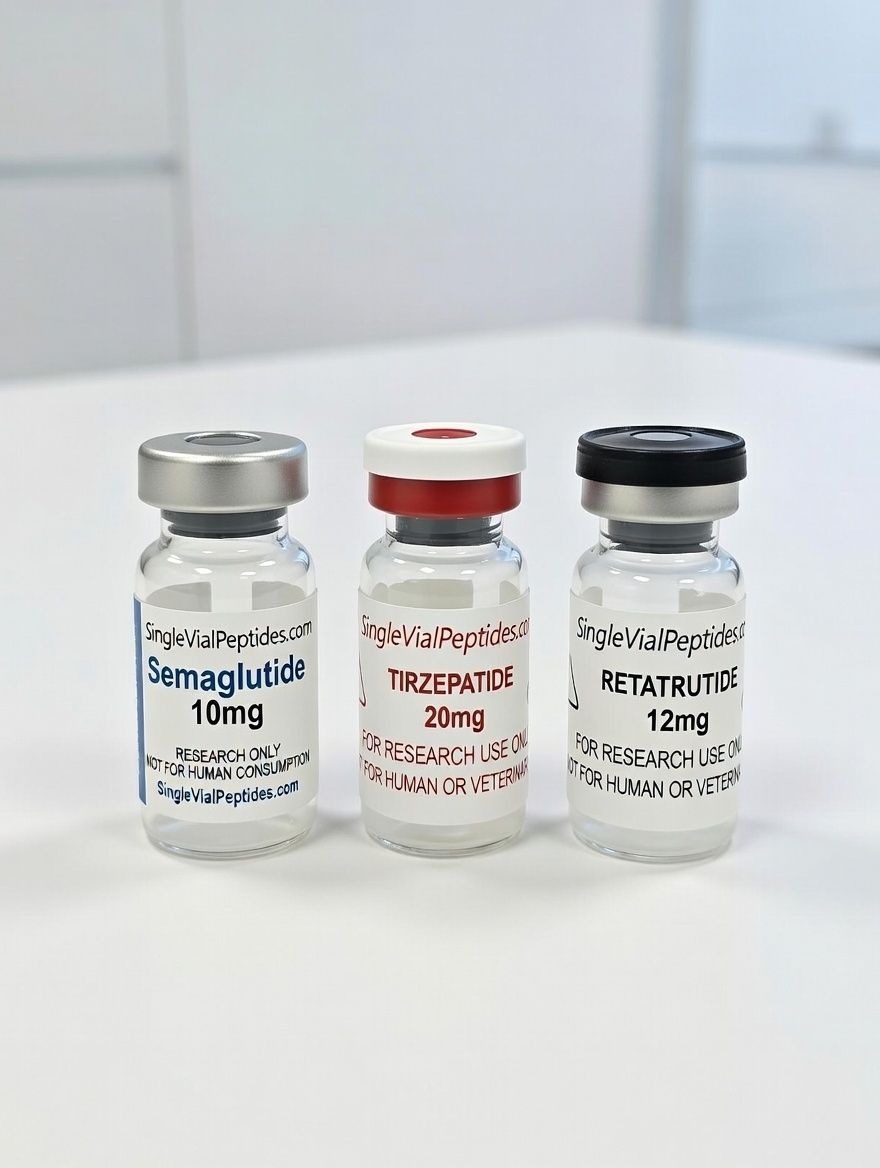
The vials on this shop are labeled research material. Adults 21 and older. Not for people or animals. At least 99 percent pure. Fill within 10 percent of the label. They are not the compounded prescriptions, the clinic menus, or the gray-market medicines these stories describe.
The direct open of the Johns Hopkins Hub page stopped on a bot check. The Robinson sentences below are the ones that page's index returned for the URL, and NewsNation had already printed two of them under his name. Reuters' own page has blocked a direct open before. The Reuters sentences below are the ones the same story's index returned for the URL Nancy Lapid's piece uses, and The Independent carried that wire. Where two outlets use different numbers, both numbers are left as printed.
The nicknames, in a science magazine
Bethany Brookshire, Scientific American, April 18, 2026, Peptides promise longevity and healing. Does the science back them up?:
"Want to speed up your recovery after an injury or a workout? Some influencers are fans of shots of BPC-157 and TB-500 for that. Want scar-free, youthful skin and thick hair? Reddit posts rave about GHK-Cu and KPV. Want to build beautiful, bulky biceps? Some fitness influencers swear shots of ipamorelin will do wonders."
On the blends, the same piece says: "In a regimen called the 'Wolverine' stack, many people combine BPC-157 with injections of TB-500, another peptide that is supposed to promote healing but has even less research behind it. The 'Wolverine' stack is named after the rapidly healing X-Men character. Add injections of GHK-Cu and KPV, and the stack is called 'glow' or 'KLOW.' People claim that GHK-Cu increases wound healing, decreases scarring and helps regenerate collagen—and that KPV, derived from a hormone naturally found in the body, reduces inflammation."
That is the outlet's account of what people claim. It is the clearest major-outlet definition opened for the blend nicknames. Scientific American also says GHK-Cu "is found in blood plasma and is an FDA-approved ingredient in topical antiaging cosmetics—but it is currently banned as an injectable because of safety concerns, such as the risk of immune reactions caused by impurities." The date on that sentence is April 2026, before the July advisory meeting. A later vote is quoted on its own page. A recommendation is not an approval, and it is not a cosmetics clearance turned into an injectable clearance.
On CJC-1295 and ipamorelin, Brookshire writes that they "are advertised as stimulating growth hormone release. Both have little clinical evidence behind them, however. Some people stack ipamorelin with GLP-1 drugs to try to lose fat while building muscle, though the effects of taking these injections together have not been studied."
Dan Cushman, the University of Utah sports-medicine doctor quoted in that piece, says FDA-approved drugs "have been tested and reviewed not just for their efficacy but also for their safety. There is very little existing information on most of these peptides, let alone on what happens if they are combined."
The shop's own labels are arithmetic, not a new molecule. Wolverine is 10mg BPC-157 and 10mg TB-500, $75. GLOW 70mg is GHK-Cu 50mg, BPC-157 10mg, and TB-500 10mg, $80. KLOW 80mg is that mix plus KPV 10mg, $85. One GLOW and one KLOW together are $150. The longer label note is Wolverine, GLOW, and KLOW.
CNN, four times
Jacqueline Howard, CNN, April 13, 2026, updated April 15, The 'Wild West' of peptides is booming:
Evan Miller of Gameday Men's Health told CNN, "Peptides are messengers, and they're messengers that are going to tell your body to do something. These messengers can be telling your body to reduce inflammation; that's a peptide called BPC-157. Or another messenger might tell it to regenerate cellular levels of the skin, like a copper peptide." That is Miller's claim to CNN.
The same article quotes Beverly Hills surgeon Lisa Cassileth saying she has prescribed BPC-157, GHK-Cu, and TB500 "to promote healing" in surgical patients, and quoting her line, "When I inject BPC-157, it creates additional new blood flow." She also told CNN she does not recommend long-term BPC-157 "if someone has active cancer," because "Anything that stimulates cellular repair can also help support cell life." Those are her words about her practice. They are not instructions, and they are not a result for a dry research vial.
Howard writes that popular GLP-1 medications "such as Ozempic, Wegovy, Zepbound and Mounjaro, are peptides," and that insulin is "probably the best-known peptide." Dr. Hal Mohammed told her he used tirzepatide, "sold under the brand names Mounjaro and Zepbound," and later "a peptide called tesamorelin" for visceral fat. CNN says both "have been approved by the FDA – tirzepatide to treat diabetes and weight management, and tesamorelin to help people with HIV lose excess abdominal fat," and that his tesamorelin use was "off-label." The Egrifta label, and the fact that a research vial is not that kit, is on Tesamorelin and Egrifta.
Chelsea Hagopian of Emory told CNN, "We worry about contamination, the source, and dosing considerations from labs with minimal oversight. How do you know you're getting an appropriate dose? There have been case reports of people getting very sick from injecting the wrong dose of a peptide or having contaminated peptides."
Finnrick Analytics, as CNN reported CEO Raphaël Mazoyer, had commissioned almost 9,900 tests since late 2024. Of those, 78 percent came back "acceptable," which CNN defines from him as the product being what it claimed, purity at least 98 percent, and quantity within 20 percent of the label. Among the 22 percent that failed, he told CNN quantity was the most common issue: "12% of samples diverge from the labeled dose by more than 20% in either direction." That is his testing program, as CNN printed it. It is not a test of this shop. This shop's stated spec is tighter on fill, within 10 percent, and at least 99 percent pure. A different lab's pass rate is not this label.
Dr. Panagis Galiatsatos of Johns Hopkins told CNN the talk of looser rules comes down to "a bit more access," and "Peptides are great when you can unlock their potential, but they still need to be properly supervised and monitored."
Associated Press via CNN, November 15, 2025, The trend of unproven peptides is spreading through influencers and RFK Jr. allies:
"More Americans are injecting themselves with unapproved chemicals that are pitched as ways to build muscle, rejuvenate skin and extend life." Eric Topol of Scripps Research Translational Institute: "None of them are proven. None of them have gone through what would be considered adequate clinical trials, but nonetheless many people are taking these. It's actually quite extraordinary."
The AP piece says "Several peptides, such as BPC-157 and TB-500, are banned by international sports authorities as doping substances." It quotes Joe Rogan telling his podcast audience, "I had tendonitis in my elbow, I started using BPC-157 and it was gone in two weeks." That is Rogan's anecdote, carried by the AP. It is not a trial.
Gary Brecka, quoted from Instagram by the AP: "Unlike synthetic pharmaceuticals, peptides are naturally recognized by your body." The same article says critics "point out that the peptides for sale are often imperfect synthetics and are taken at doses much higher than any peptides in the body." It names ipamorelin and CJC-1295 among the peptides Brecka sells, "both of which the FDA has flagged for serious safety risks," and says those vials carry "research use only."
Paul Knoepfler of UC Davis: "Research-grade peptides are going to have junk in them. They're going to have chemicals used in the purification process and fragments of peptides that you don't want." And: "What's actually in there? If someone injects it under their skin, what are they getting?" Anita Gupta, then of the Johns Hopkins School of Medicine: "Patients should be really asking their health care professionals: Are these medications safe long term? That's the question I would ask if I was a patient."
Associated Press via CNN, June 29, 2026, FDA panel on peptides will include experts who promote the unproven chemicals favored by RFK Jr.:
"The substances are sold online and promoted by wellness clinics as a means to build muscle, heal injuries and look younger, though there's little evidence behind those claims. Peptide sellers often skirt U.S. regulations by labeling their products as 'for research use only,' since the FDA doesn't regulate research chemicals."
"For several years, the FDA has warned Americans about the risks of injecting chemicals with names like BPC-157 and TB-500, which have not been extensively studied in humans. Both drugs are considered doping substances by international sports authorities." The piece also says panelist Gabriel Alizaidy "promotes BPC-157, GHK-Cu and other peptides" on Instagram and TikTok.
Jacqueline Howard, CNN, published July 22, 2026, updated July 24, The future of peptides in the US is about to become clearer:
CNN's list of what was under review, in CNN's words: "BPC-157, proposed for treating ulcerative colitis. KPV for wound healing and inflammatory conditions. TB-500 for wound healing. MOTS-c for obesity and osteoporosis." CNN also lists emideltide, Semax, and epitalon, which this shop does not sell.
CNN's tallies, printed on that page: BPC-157 free base, 8-6, one abstention. BPC-157 acetate, 8-6, one abstention. KPV and TB-500, 8-6, one abstention. MOTS-c, 7-5, two abstentions. Epitalon, 7-4, one abstention. Semax, 8-5, one abstention. Emideltide, 6-7, one abstention, and CNN calls that the only peptide without majority support. Other outlets have printed a different epitalon count. This paragraph uses CNN's figures for CNN's article. The vote is advisory. Scott Brunner of the Alliance for Pharmacy Compounding told CNN, "The committee usually looks at research clinical trials, and if there's supporting research clinical trial data, there'll be a recommendation that they be added to a list of drugs that compounding pharmacies can prepare. That data just doesn't exist for most of these peptides."
Elizabeth Rebello of MD Anderson, on CNN: "I'm concerned that we're responding to a market-induced demand rather than a decision based in solid science." Hal Mohammed, on CNN: "That's where the real danger lives, and that's where the enforcement belongs. Keeping this in a regulated pharmacy is not the risk in the room. The gray market pipeline is, and it operates in the open because we let it."
Eric Topol, quoted by CNN from an April call hosted by the Harvard T.H. Chan School of Public Health: "I think this is a disaster in the works, because these peptides have no data to support their safety and efficacy."
Edgar Asebey, a Frier Levitt lawyer, told CNN, "We currently don't know the long-term effects of many of these peptides; what are their toxicities, adverse effects or even their drug interactions." And: "None of the peptides currently being considered for compounding are FDA approved drugs."
CNN's video pages from July 31, 2026, Inside the viral world of peptides and Inside the gray market peptide industry, are short clips. The text CNN printed with them says injectable peptides have been "popping up all over the internet with promises to help people lose weight, build muscle, improve skin health and even repair tissue," and that Bijan Hosseini "found a seller in under an hour, no prescription or doctor required," in "a booming, largely unregulated gray market, where independent testing shows a majority of samples fail basic safety checks." The clip text does not name which peptides failed, and it does not name this shop.
NPR
Will Stone, NPR, updated July 24, 2026, FDA panel supports broadening access to peptides popular on the gray market:
"Seven different peptide therapies — none of which are FDA-approved drugs — were under consideration. Currently, these peptides can't be made in the U.S., except for research purposes, leading many peptide users to buy unvetted substances sold online, with disclaimers such as 'for research use only' and 'not for human consumption.'"
"These peptides are promoted for a wide range of uses and are often taken together, including for injury recovery, muscle growth and fat loss, improving athletic performance, enhancing metabolism and more."
"If the agency takes the panel's recommendations, clinicians could have the ability to prescribe six peptide therapies: BPC-157, MOTS-c, KPV, TB-500, Epitalon and Semax."
FDA official Russell Wesdyk, on NPR: "You will see many many different forms. We can't create quality standards until we actually know what it is."
Jessica Duncan of Ivím Health, in the All Things Considered transcript on that page: "Many of my patients are already using these drugs. They're just getting them from the worst possible places. They come for a visit. They hold up a vial with no label, no dose, no ingredient list - something they ordered based on a video that they saw on their phone."
Brian Lee of USC, on NPR: "I think this endorsement can be potentially harmful and I cannot in good conscience vote yes." Brigham Buhler, on NPR: "What we are advocating for is not the Wild West. What we are advocating for is to slow down or shut down the gray and black market."
NPR also says the committee was "tasked with reviewing data that supports using these peptides to treat a variety of specific conditions, such as BPC-157 for treating ulcerative colitis," and that if compounding were later allowed, "clinicians would have discretion to write prescriptions outside of those narrow indications." A proposed use on a docket is not a proven use, and it is not a dose.
Fox News, before the vote
Angelica Stabile, Fox News, the July 23, 2026 preview 7 peptides under FDA review. Fox says the peptides "are not FDA-approved" and "are widely available through wellness clinics, compounding operations and gray-market online sellers." Fox says, "According to Reuters, consumer demand is likely to 'remain strong.'"
Fox's proposed uses, as Fox printed them: BPC-157, ulcerative colitis. TB-500, wound healing. KPV, "wound healing and inflammatory condition." MOTS-c, obesity and osteoporosis. Fox also lists forms the nominators proposed, including injections. This page does not reprint those forms as steps.
Alex Tatem, an Indiana urologist, told Fox: "BPC-157 or TB-500 are compounds that can help facilitate healing after injury and have been shown in multiple studies to be incredibly safe when administered — which is interesting when you compare that to the over-the-counter options that we use now for aches and pains, like ibuprofen." He also told Fox, "There is no other drug on the market that had that sort of safety record," and he attributed that to "natural substances that our bodies make." He described adverse-event rates "well under 0.1%" in real-world data he said covered 2014 to 2023. Those are Tatem's claims to Fox.
On the same page, Fox says the FDA "has publicly stated that there is not enough evidence from human clinical trials on the safety or efficacy of these drugs," and that "a peptide's similarity to a naturally occurring substance does not eliminate potential risks." Marc Siegel told Fox the substances "need careful study," that Kennedy had told him "not all peptides are created equal, whereas some are helpful, others may not be and need further study," and "I'm concerned about the impact some may have on the kidneys. I would like to see rigorous clinical trials before approval. I am not convinced the data is fully there yet."
Tatem also told Fox, "this committee is just issuing a recommendation to the FDA. The FDA can take it or leave it."
The Guardian
Nicola Davis, The Guardian, April 4, 2026, What are peptides, are they safe and is there evidence to back up the hype?:
"Among others, the US podcaster Joe Rogan has alleged the peptides BPC-157 and TB-500 – a combination known as the 'Wolverine stack' after the Marvel superhero – help with injury recovery. Other popular peptides include CJC-1295, MK-677 and ipamorelin that are touted as helping build muscle, and GHK-Cu, which is purported to have anti-ageing effects."
The Guardian then quotes a U.S. review of peptides marketed for musculoskeletal injuries. On BPC-157, that review as carried by the Guardian: it "demonstrated potential benefits in tendon and muscle repair, but these findings are largely unvalidated in human trials," with "no randomised control trials in humans relating to such uses." On TB-4 and TB-500: "some signs of promoting blood vessel formation and tissue repair in cell studies and animal research," and "human data around musculoskeletal conditions are lacking." The Guardian says the reviewers "said there had been no studies of TB-500 in human participants," and that both appear on the World Anti-Doping Agency prohibited list. The reviewers' line, as the Guardian prints it: "Importantly, information regarding the indications, dosing, frequency and duration of treatment remains unknown."
Katie Thornton, The Guardian, July 30, 2026, 'It's a peptide wild west':
"Rogan is especially boosterish about the peptides BPC-157 and TB-500, together known as the 'Wolverine stack' – a reference to the Marvel character who can quickly regenerate lost limbs and heal wounds." Thornton writes that Kennedy told Rogan, "I'm a big fan of peptides," and "I've used them myself," and that he "hoped to make several of the most hyped peptides – including Rogan's beloved Wolverine stack – easier to get a hold of."
Janet Woodcock, the former FDA official, told ProPublica in a quotation the Guardian carries: reclassification is not "supposed to be a route for unapproved drugs to get into the market." And: "It would be a disruption of the societal pact we have had since 1962 that drugs will be studied to see if they work before they are marketed in the US."
Pharmacist Mohammed Chammout told the Guardian that after Kennedy's Rogan appearance, "People every day asked me, 'Can I get this peptide? How do I buy it?'" He said patients showed him a phone and said TikTok "told me that these are all legal." His closing line in the piece: "This is a way to get the peptides in the market and produce revenue off them without having the FDA legality behind it. It's like the wild west right now."
Reuters, The Verge, and the Wolverine study
Reuters, September 15, 2026, Use of untested 'Wolverine' peptide backed by US Health Secretary Kennedy on the rise, study finds. The indexed text of that URL:
"An experimental peptide backed by U.S. Health Secretary Robert F. Kennedy Jr. and marketed online for pain, healing and performance enhancement is being used for a wide range of ailments despite little safety and efficacy evidence from human studies, a new analysis found."
"The peptide, BPC-157, has not been approved for use in the United States but has attracted consumers in a gray market, bolstered by social media posts that claim benefits for muscle growth and injury recovery not backed by scientific testing. It is often taken together with a second peptide, TB-500, in a combination popularly known as the 'Wolverine stack.'"
The same indexed text says analysts estimated BPC-157 and other peptides "could quickly become a $2 billion to $3 billion market if legitimized," that nference reviewed more than 15 million records and identified 1,039 patients, that new confirmed users "increased 33-fold between 2020 and 2026," and that reasons for use were documented in 644 patients, "ranging from sports injuries and chronic pain to gastrointestinal disorders." The Independent's September 16 reprint of that wire is here. NewsNation's September 21 piece, Wolverine peptide claims to accelerate healing and recovery, uses "suggest" for the social-media claims and calls the pairing the Wolverine stack. MedPage Today's September 16 roundup used the same "Wolverine stack" name in a short item. This page does not merge NewsNation's later wording with the Reuters lead.
Victoria Song, The Verge, October 7, 2026, The scariest thing about gray-market peptides is how little we know, writes up the same nference preprint with different figures, so they stay separate. She calls BPC-157 "one half of the infamous 'Wolverine' stack." She says it "was originally found in gastric juice in 1993 and is thought to promote injury recovery. It supposedly works by creating new blood vessels, promoting cell growth, and repairing damaged tissues like tendons, muscles, and ligaments." "Supposedly" is her word. She says a 2025 systematic review "found only 35 preclinical studies and a single clinical study for BPC-157 in humans," and that the same review "states that, in 2024, there were over 50 million views for BPC-157 videos on YouTube and TikTok," with Google Trends "a 1,600 percent increase in traditional web searches for BPC-157 in the United States in the last five years."
Her account of the preprint: "roughly 54 confirmed patients using BPC-157 in Q1 2022" and "1,018 in Q1 2026." Venky Soundararajan told her that "about 33 percent of patients who used BPC-157 didn't pursue any other therapies or drug use. Roughly half, however, stacked it with other substances," and that "Chief among those were testosterone, non-steroidal anti-inflammatory drugs, and TB-500, the other half of the Wolverine stack." He also told her the majority in that extract were taking it orally, "followed by injections," and that "from the time the product is first used and the time they show up to discuss their use with a doctor, at least two months has elapsed." Song writes that "66 percent of the cases showed no documented response on whether BPC-157 worked or not," and that "It's possible that some were taking another substance entirely." Her ending line: "We don't know enough, but BPC-157 isn't going away anytime soon." She says the same limit "goes for all the commonly used gray-market peptides."
Johns Hopkins Hub
Johns Hopkins Hub, September 16, 2026, What to know about gray-market peptides. The index of that URL quotes Christopher Robinson:
"People need to understand that there's a huge difference between peptides that have been rigorously studied and approved as medications, such as insulin and GLP-1 weight-loss drugs, and these newer compounds."
"These other peptides haven't been adequately studied in humans and aren't approved by the Food and Drug Administration. Anyone who uses them needs to understand the risks."
"All of these drugs are purely experimental." And: "Vials often come with 'for research purposes only' labels, meaning they are intended for research only, not regular clinical use."
"There's real potential here. But potential isn't the same as proof."
The Hub's indexed text also says much of the trade comes "from overseas suppliers—China is the biggest producer," and that Chainalysis "found that money flowing to gray-market peptide vendors is on track to surpass $100 million this year, up from $4 million in 2024," after a period when the same firm "averag[ed] just $200,000 in monthly inflow volume." Those figures are the Hub's account of Chainalysis. They are not a count of this shop.
What was opened for each name on this shop
BPC-157. CNN, Fox, NPR, Scientific American, both Guardian pieces, Reuters, The Verge, and the Hub all name it. The proposed use Fox and CNN print for the July docket is ulcerative colitis. The social-media claim Reuters prints is muscle growth and injury recovery, "not backed by scientific testing." The shop vial is BPC-157 5mg. The paper note is What papers say about BPC-157.
TB-500. The same outlets name it as the other half of the Wolverine stack. Fox and CNN print the docket's proposed use as wound healing. The Guardian's account of the U.S. review says the reviewers found no human participant studies of TB-500 for musculoskeletal conditions. The shop vial is TB-500 5mg.
GHK-Cu. Scientific American, CNN's April feature, the AP's June panel story, and the Guardian's April explainer name it. The claims they attribute to other people are skin, collagen, scarring, and anti-aging. Scientific American separates a topical cosmetic use from an injectable ban as of April 2026. The shop vial is GHK-Cu 50mg.
KPV. Scientific American, CNN, Fox, and NPR name it. The claim they print is wound healing and inflammatory conditions. The shop vial is KPV 10mg.
Wolverine, GLOW, KLOW. Reuters, The Guardian, Scientific American, The Verge, and NewsNation define Wolverine, or the Wolverine stack, as BPC-157 plus TB-500. Scientific American is the major piece opened here that also defines "glow" or "KLOW" as that pair plus GHK-Cu and KPV. None of those pieces report a trial of the blend as a blend. The shop pages are Wolverine, GLOW, and KLOW.
MOTS-c. CNN, Fox, and NPR name it. The proposed uses they print are obesity and osteoporosis. Fox also says the nominators listed a subcutaneous injection form. That is their list of paperwork, not a method. The shop vial is MOTS-c 10mg. The mouse papers stay on their own page.
CJC-1295 and ipamorelin. The AP/CNN November piece, Scientific American, and the Guardian's April explainer name them, as muscle or growth-hormone claims, with the outlets saying the human evidence is thin. They were not on the July chart NPR and CNN list. The shop vial is CJC-1295 (no DAC) plus ipamorelin.
Tesamorelin. CNN's April feature is the major page opened here that names it. CNN says the FDA approved it "to help people with HIV lose excess abdominal fat," and quotes a physician describing his own off-label use. The research vial is not that approved kit.
Tirzepatide and semaglutide. CNN treats Ozempic, Wegovy, Mounjaro, and Zepbound as approved peptide medicines, in a different category from BPC-157 and the July list. Robinson's Hub line draws the same line: insulin and GLP-1 weight-loss drugs on one side, "these newer compounds" on the other. A research vial of tirz or sema is not those pens. Two names, one chemical is the brand-name note.
Retatrutide. The July dockets CNN, Fox, and NPR printed do not list it. The opened CNN peptide features treat approved GLP-1 pens as a separate category and do not walk through Lilly's retatrutide trials. Lilly's own pages, and the filing date, stay on Retatrutide is still not approved. A CNN story on Brazil's weight-loss black market mentions a product sold as retatrutide. That page was not opened in full for this note, so its sentences are not quoted here.
Sermorelin. None of the CNN, Fox, Guardian, NPR, Scientific American, Verge, or Hub pages opened for this roundup named sermorelin. The record that was opened for the molecule is the discontinued Geref file, on Sermorelin acetate in the record. This page will not invent a cable-news sermorelin quote.
NAD+. NAD+ is not a peptide. The same opened news pages did not run a NAD+ item. The clinic page already quoted is What the record says about NAD+. A coenzyme does not inherit a peptide headline.
What this page will not do
It will not turn Tatem's safety claim, Cassileth's surgical claim, Rogan's elbow story, or a TikTok healing claim into a shop result. It will not print a dose, a mix, a draw, or a site. It will not treat a 503A bulks vote as an approval. It will not treat "research use only" on someone else's vial as a test of this one.
The July tallies, and the lines that say a recommendation is not an approval, are also in The July 2026 peptide vote is not an FDA approval.
Sources
- Jacqueline Howard, CNN, April 13, 2026. The 'Wild West' of peptides is booming.
- Associated Press via CNN, November 15, 2025. The trend of unproven peptides.
- Associated Press via CNN, June 29, 2026. FDA panel on peptides will include experts who promote the unproven chemicals.
- Jacqueline Howard, CNN, July 22, 2026, updated July 24. The future of peptides in the US.
- CNN video text, July 31, 2026. Inside the viral world of peptides and Inside the gray market peptide industry.
- Bethany Brookshire, Scientific American, April 18, 2026. The science behind the peptide craze.
- Nicola Davis, The Guardian, April 4, 2026. What are peptides.
- Katie Thornton, The Guardian, July 30, 2026. It's a peptide wild west.
- Will Stone, NPR, updated July 24, 2026. FDA panel supports broadening access. The same story on the main NPR host: npr.org.
- Angelica Stabile, Fox News, July 23, 2026. 7 peptides under FDA review.
- Reuters, September 15, 2026. Use of untested 'Wolverine' peptide.
- The Independent, September 16, 2026. Wolverine peptide.
- NewsNation, September 21, 2026. Wolverine peptide claims.
- Victoria Song, The Verge, October 7, 2026. How little we know.
- Johns Hopkins Hub, September 16, 2026. What to know about gray-market peptides.
Research vials. 21 and older. Not for people or animals. Not medical advice.
Onderzoeksflacons. 21 jaar en ouder. Niet voor mensen of dieren. Geen medisch advies.