 Single Vial Peptides
Ten units on a video is not your milligrams
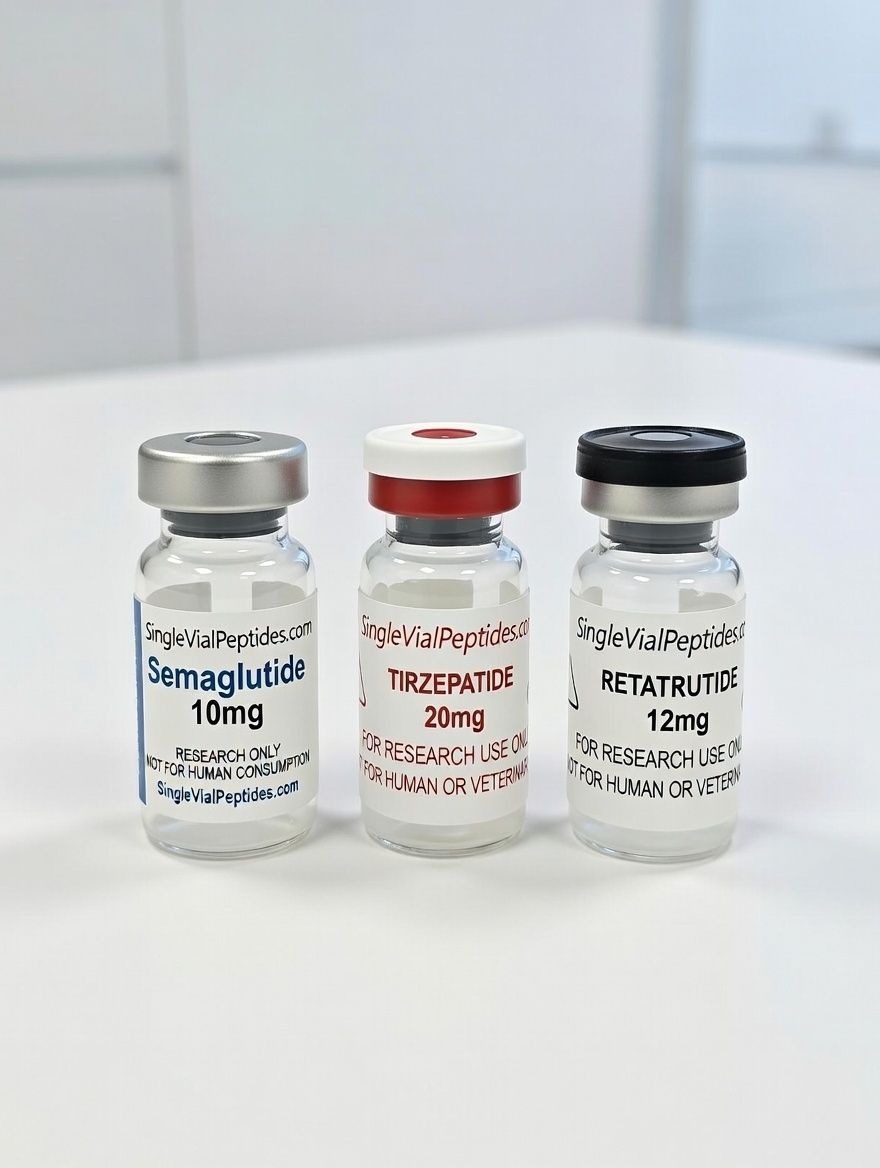
Someone on a video holds up a syringe and says a number. Ten units. Twenty-five. Forty. That number is a mark on their syringe. It is not the milligram number printed on your vial. You do not know their liquid. You do not know their label. You copied a mark.
The short map of the other numbers people mix up, including gauge and millimeters, is five different numbers.
That mark was built for insulin, not for your vial. U-100 insulin is insulin made so that 100 units of insulin sit in 1 milliliter. Lilly's Humulin R label says it on the patient line: U-100 (100 units/mL). A syringe printed for that insulin puts the 100 line at 1 mL of liquid. That is the only identity this page will use. 100 units = 1 mL. The wording is on DailyMed.
On a barrel that actually says U-100, every other line is that same identity, scaled. Divide the unit count by 100. That quotient is milliliters. The 100 line is 1 mL. One-tenth of the way to 100 is one-tenth of a milliliter. The barrel can be a short 0.3 mL syringe, a 0.5 mL syringe, or a 1 mL syringe. The ruler looks different. The identity does not change. If the barrel does not say U-100, do not use this line.
What the mark does not know
Insulin units are a measure made for insulin. A peptide vial is labeled in milligrams. Milligrams are weight. The lines on that syringe are not milligrams of peptide. When the liquid inside is not U-100 insulin, the 100 line is still 1 mL of volume. It is only volume. The video left out the number that turns volume into weight.
That number is the concentration. Concentration is milligrams per milliliter. It depends on how much material is in the container and how much liquid is in there with it. Two people can both say the same unit count. If their liquids are different strengths, the same mark is a different weight of material. Copying the mark copies the ruler. It does not copy the bottle.
A video cannot see the label on your container. A regulator does not turn a stranger's unit count into the weight in that container either.
The longer note on the ruler is units are a ruler. The longer note on why a volume is not a weight is a volume is not a dose.
What the calculator will not invent
The mix calculator is the same math with two boxes. You type milligrams. You type milliliters. It shows milligrams per milliliter, and the milligrams in 0.1 mL, 0.5 mL, and the other common volumes. It will not decide a video was right.
If you do not already have a milligram number from a prescriber or a pharmacy label, do not borrow one. The page will not invent one. A borrowed count from a clip is a story told in a confident voice.
If a prescriber or a pharmacist already gave you their number, their label wins. Use their strength, not a thumbnail. If the medicine in your hand is a finished Lilly pen, stop. A pen is not a research vial plus a U-100 ruler. The pen has Lilly's own instructions: lilly.com.
Look at your own label before you watch the clip again. The name has to match what you think you have. The milligram number has to be the one on the glass. A fill window means the weight may not match the sticker out to the decimal. None of that is visible in "I do 10 units." You cannot see their mix.
So keep the only conversion this note is willing to give you. On a U-100 syringe, 100 units equals 1 mL. A unit count is a place on that volume ruler. It becomes a weight only after you know the milligrams per milliliter of the liquid you actually have. Their number stays theirs.
U-100 means 100 units in each milliliter of that insulin. It is not a fact about how much of any other material belongs in a person.
Vials on singlevialpeptides are research material, for adults 21 and older, not for people or animals.
Onderzoeksflacons. 21 jaar en ouder. Niet voor mensen of dieren. Geen medisch advies.