 Single Vial Peptides
CJC-1295, no DAC, and ipamorelin
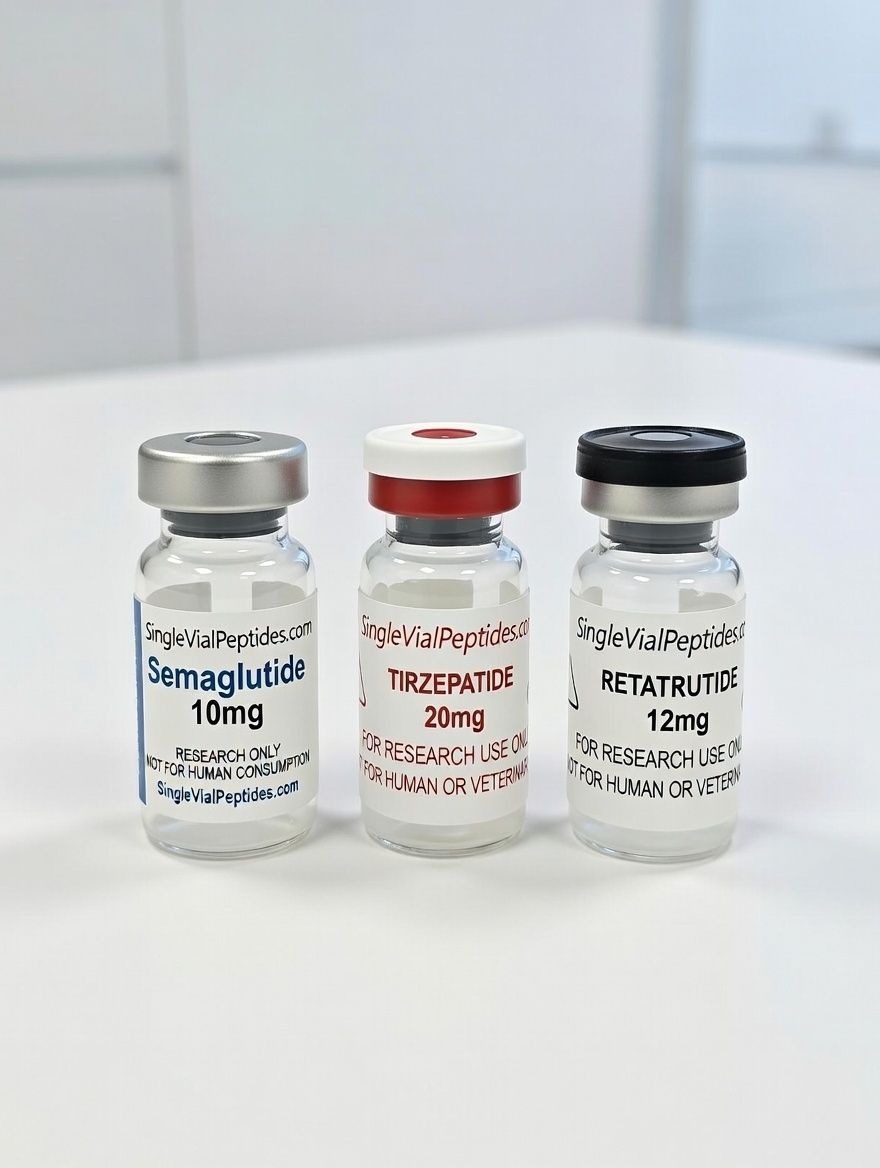
The catalog name is CJC-1295 (no DAC) + IPA 5mg/5mg. The catalog price is $40. The path is CJC-1295 (DAC 없음) + IPA 5mg/5mg. It is research material, at least 99 percent pure, with fill within 10 percent of the label. Sale is to adults 21 and older. It is not for people or animals. This shop is not a pharmacy, and this page is not medical advice.
People use one name for two different substances, and a third name for ipamorelin. The papers below studied those substances separately. They did not study this blend. This page does not turn their experiments into a protocol.
CJC-1295 in the papers that used that name
Jetté and colleagues, Endocrinology, 2005, worked on human growth hormone-releasing factor, fragment 1-29. They wrote that attaching a peptide to the free thiol on Cys34 of serum albumin "is a useful tool to extend plasma half-life." In male Sprague Dawley rats, they wrote: "The best compound, CJC-1295, showed a 4-fold increase in GH area under the curve over a 2-h period compared with hGRF(1-29)." That comparison is their rat experiment.
They defined the compound they called CJC-1295 as "a tetrasubstituted form of hGRF(1-29) with an added N epsilon-3-maleimidopropionamide derivative of lysine at the C terminus." It "was found to be present in plasma beyond 72 h." They called it "a stable and active hGRF(1-29) analog with an extended plasma half-life." The abstract says "extended." It does not print a half-life in hours or days. "Beyond 72 h" is presence in rat plasma, not a half-life, and not a figure for this vial.
Teichman and colleagues, Journal of Clinical Endocrinology and Metabolism, 2006, studied "CJC-1295, a long-acting GHRH analog" in healthy adults ages 21 to 61, in two randomized, placebo-controlled, double-blind, ascending-dose trials. They wrote: "After a single injection of CJC-1295, there were dose-dependent increases in mean plasma GH concentrations by 2- to 10-fold for 6 d or more and in mean plasma IGF-I concentrations by 1.5- to 3-fold for 9-11 d. The estimated half-life of CJC-1295 was 5.8-8.1 d." The range 5.8 to 8.1 days is Teichman's figure for the long-acting analog in that paper. This note does not reassign it.
FDA's briefing for the December 4, 2024 Pharmacy Compounding Advisory Committee meeting treats that human literature as the DAC form. It names Teichman et al. 2006 among three studies in which CJC-1295 DAC was given to healthy subjects, not as a compounded product.
What people mean by no DAC
The same briefing says the name has not been stable, and that inconsistent naming is a problem because a reference may not show which substance is meant. FDA then draws the distinction on this label.
FDA wrote: "CJC-1295-related BDSs are analogues of growth hormone releasing hormone (GHRH). ConjuChem Biotechnologies developed CJC-1295 with a maleimidopropionamide-lysine (MPA-Lys) unit added at the C terminus which we refer to as 'CJC-1295 DAC (free base)'. There have been many modifications to GHRH over time including CJC-1295 that was synthesized without DAC, which is identified as 'CJC-1295 (free base)' in this document."
FDA expands DAC as drug affinity complex. In the quotation, that is the maleimidopropionamide-lysine unit. No DAC is the version FDA says was synthesized without that unit. FDA calls them two active moieties, CJC-1295 (free base) and CJC-1295 DAC (free base), "which are not interchangeable." The briefing later says: "Therefore, the pharmacological profile of the CJC-1295 DAC cannot be extrapolated to CJC-1295 without the DAC modification."
That is why Teichman's 5.8 to 8.1 days stays attached to Teichman's paper. FDA says that profile is not to be carried over to the form without DAC. This page states no half-life for the no-DAC form. No paper opened for this note gave one.
Of the five CJC-1295-related substances it reviewed, FDA wrote: "There is no applicable United States Pharmacopeia (USP) or National Formulary (NF) drug substance monograph for any of the substances, and none of the substances are a component of an FDA-approved drug." The cover page says FDA would not issue a final determination until the committee process and the rest of the review were finished. This vial is not offered as an approved drug.
What ipamorelin is
Raun did not present ipamorelin as a GHRH analog. Raun and colleagues, European Journal of Endocrinology, 1998, wrote: "Ipamorelin is a pentapeptide (Aib-His-D-2-Nal-D-Phe-Lys-NH2), which displays high GH releasing potency and efficacy in vitro and in vivo." In vitro, they wrote, it released growth hormone from primary rat pituitary cells. They also reported results in pentobarbital-anaesthetised rats and in conscious swine. Those are Raun's cell, rat, and swine experiments. They are not a schedule for a person.
On selectivity, the paper says the comparison was made in swine. Raun wrote: "Very surprisingly, ipamorelin did not release ACTH or cortisol in levels significantly different from those observed following GHRH stimulation. This lack of effect on ACTH and cortisol plasma levels was evident even at doses more than 200-fold higher than the ED50 for GH release." That multiple is their swine experiment, not a dose from this shop. Their conclusion: "ipamorelin is the first GHRP-receptor agonist with a selectivity for GH release similar to that displayed by GHRH."
FDA's briefing for the October 29, 2024 meeting evaluates ipamorelin (free base) and ipamorelin acetate. It calls the free base a pentapeptide hormone and says ipamorelin, as free base or acetate, is a synthetic pentapeptide that acts as a ghrelin mimetic, stimulating growth hormone release from the anterior pituitary without major effects on ACTH or cortisol. The briefing states: "There is no applicable United States Pharmacopeia (USP) or National Formulary (NF) drug substance monograph for ipamorelin (free base) or its acetate form, and neither is a component of an FDA-approved drug." The cover page again says a final determination waited on the rest of the process.
This vial puts ipamorelin in the same bottle as CJC-1295 (no DAC). Raun did not study that pair. Jetté and Teichman did not study that pair. This page has no finding about the blend.
What the catalog is selling
One research vial. The label is 5mg of CJC-1295 (no DAC) and 5mg of ipamorelin. Catalog price, $40. Purity at least 99 percent. Fill within 10 percent of the label. Adults 21 and older. Not for people or animals. Not a pharmacy. Not medical advice. Not a protocol.
CJC-1295 (DAC 없음) + IPA 5mg/5mg.
The July 2026 vote is quoted on its own page
MedPage and Pharmacy Times printed the committee tallies. Those tallies, and the lines saying a recommendation is not an approval, are in The July 2026 peptide vote is not an FDA approval. CJC-1295 and ipamorelin were not on that July chart. This page does not turn a vote into a shop claim.
What CNN and the other outlets wrote
These two were not on the seven-peptide list CNN, Fox, and NPR printed for the July meeting. The outlets that did name them, in the pages opened for What CNN, Fox, and the other outlets wrote, treated them as a muscle or growth-hormone claim with thin human evidence. Scientific American: they "are advertised as stimulating growth hormone release. Both have little clinical evidence behind them." Scientific American. The Guardian's April 4 explainer groups "CJC-1295, MK-677 and ipamorelin" as peptides "touted as helping build muscle." The Guardian. The Associated Press, via CNN on November 15, 2025, says Gary Brecka sells ipamorelin and CJC-1295, "both of which the FDA has flagged for serious safety risks," with vials labeled "research use only." CNN.
Sources
- Jetté et al., Endocrinology, 2005. PubMed 15817669.
- Teichman et al., Journal of Clinical Endocrinology and Metabolism, 2006. PubMed 16352683.
- Raun et al., European Journal of Endocrinology, 1998. PubMed 9849822.
- FDA briefing, Pharmacy Compounding Advisory Committee, December 4, 2024. CJC-1295-related bulk drug substances.
- FDA briefing, Pharmacy Compounding Advisory Committee, October 29, 2024. Ipamorelin-related bulk drug substances.
Research vials. 21 and older. Not for people or animals.
연구용 바이알. 21세 이상. 사람이나 동물에게 쓰지 않습니다. 의학적 조언이 아닙니다.