 Single Vial Peptides
Wolverine, GLOW, and KLOW are just blends in one vial
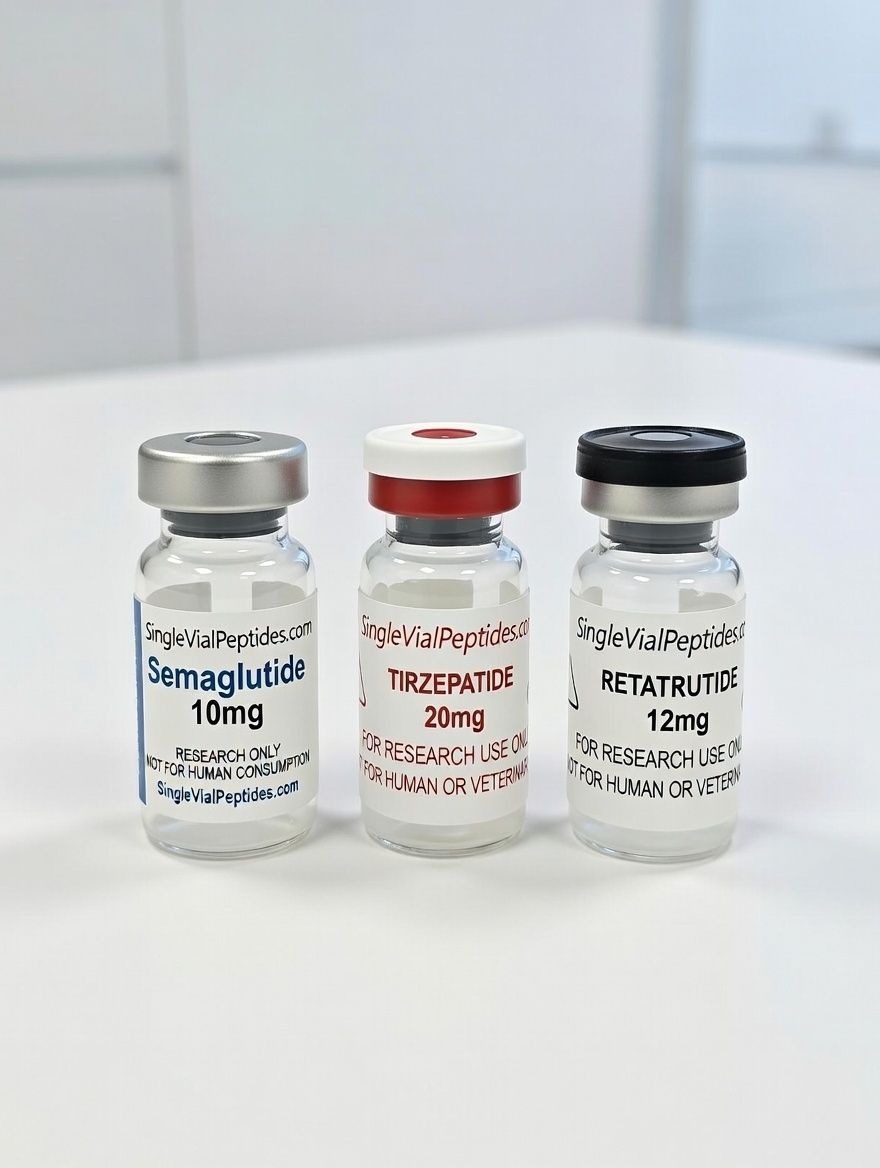
The nicknames are doing a lot of work. Here is what is actually in the bottle, and then what the major outlets wrote when they used the same nicknames.
Wolverine is one vial with 10mg of BPC-157 and 10mg of TB-500. $75. People also call this the BPC/TB blend. Same thing.
GLOW is one 70mg vial: 50mg GHK-Cu, 10mg BPC-157, 10mg TB-500. $80.
KLOW is one 80mg vial: the GLOW mix plus 10mg of KPV. $85.
One GLOW and one KLOW together are $150 if you want both.
None of these blends are FDA-approved drugs. The names came from chats, not from a company launch. The milligrams above are the labeled amounts. Every research vial is at least 99% pure, and the fill is within 10% of the label. Adults 21 and older. Not for people or animals.
What the outlets call these names
This shop is not going to invent a mechanism for a blend. The outlets already printed what they say people claim. The full set of quotations, including BPC-157, TB-500, GHK-Cu, KPV, MOTS-c, CJC-1295, ipamorelin, tesamorelin, and the GLP-1 pens, is What CNN, Fox, and the other outlets wrote. The lines on this page are the ones that name the blends.
Scientific American, April 18, 2026, is the major piece opened here that defines all three nicknames in one paragraph. Bethany Brookshire writes: "In a regimen called the 'Wolverine' stack, many people combine BPC-157 with injections of TB-500, another peptide that is supposed to promote healing but has even less research behind it. The 'Wolverine' stack is named after the rapidly healing X-Men character. Add injections of GHK-Cu and KPV, and the stack is called 'glow' or 'KLOW.' People claim that GHK-Cu increases wound healing, decreases scarring and helps regenerate collagen—and that KPV, derived from a hormone naturally found in the body, reduces inflammation." That "people claim" is the magazine's attribution. It is not a trial of a GLOW vial or a KLOW vial. The piece is The science behind the peptide craze.
Reuters, September 15, 2026, uses the stack name for two peptides, not for the copper blend. The indexed text of the Reuters story says BPC-157 "is often taken together with a second peptide, TB-500, in a combination popularly known as the 'Wolverine stack,'" and that social posts "claim benefits for muscle growth and injury recovery not backed by scientific testing." The same text says the peptide "has not been approved for use in the United States." The Independent reprinted that wire on September 16: Wolverine peptide.
The Guardian uses the same two-peptide definition. Nicola Davis, April 4, 2026: Joe Rogan "has alleged the peptides BPC-157 and TB-500 – a combination known as the 'Wolverine stack' after the Marvel superhero – help with injury recovery." Katie Thornton, July 30, 2026: Rogan is "especially boosterish about the peptides BPC-157 and TB-500, together known as the 'Wolverine stack.'" Neither Guardian piece defines GLOW or KLOW. Davis. Thornton.
The Verge, October 7, 2026, calls BPC-157 "one half of the infamous 'Wolverine' stack" and calls TB-500 "the other half." Victoria Song writes that BPC-157 "is thought to promote injury recovery" and "supposedly works by creating new blood vessels, promoting cell growth, and repairing damaged tissues like tendons, muscles, and ligaments." "Supposedly" is her word. She also writes that the nference preprint cannot show the peptide works, and that some of the recorded product may have been "another substance entirely." The Verge.
NewsNation, September 21, 2026, headline and deck: the Wolverine peptide "claims to accelerate healing and recovery." The body says social posts "suggest" muscle growth and injury recovery, and that users "often take it with TB-500" as the Wolverine stack. NewsNation.
Fox News, July 23, 2026, does not use the nickname Wolverine in the preview that was opened. It does print the docket language for the two ingredients: BPC-157 proposed for ulcerative colitis, TB-500 proposed for wound healing. Alex Tatem told Fox that "BPC-157 or TB-500 are compounds that can help facilitate healing after injury and have been shown in multiple studies to be incredibly safe when administered." On the same page Fox says the FDA has said there is not enough human clinical-trial evidence on safety or efficacy, and Marc Siegel told Fox, "I am not convinced the data is fully there yet." Fox News. Tatem's sentence is his claim. Siegel's sentence is his caution. This page does not pick one and drop the other.
CNN's July 22 piece, updated July 24, prints the same proposed uses and the vote counts: BPC-157 and TB-500 each 8-6 with one abstention, on the forms the committee considered. KPV, which is the extra ingredient in KLOW, was on that same 8-6 line at CNN. GHK-Cu was not on CNN's list of the seven. CNN. A vote to recommend a compounding category is not an approval. That point is spelled out in The July 2026 peptide vote is not an FDA approval.
Christopher Robinson, in the Johns Hopkins Hub piece of September 16, 2026, is not talking about a blend by name. The indexed text of that Hub page quotes him: "These other peptides haven't been adequately studied in humans and aren't approved by the Food and Drug Administration." And: "All of these drugs are purely experimental." And: "There's real potential here. But potential isn't the same as proof." A direct open of the Hub URL stopped on a bot check. Those sentences are the ones the page index returned, and NewsNation had already printed the first of them under his name.
What those pieces did not do
They did not test a vial labeled GLOW or a vial labeled KLOW. Scientific American is describing a stack people talk about. Reuters, The Guardian, The Verge, and NewsNation are describing BPC-157 with TB-500. Fox and CNN are describing separate docket lines for BPC-157, TB-500, and KPV. Putting three or four of those names on one label does not add the articles together.
They also did not print a dose, a mix, or a way to draw a syringe. Where an outlet mentions an injection, that is the outlet describing what people or nominators said. It is not a method on this page.
The paper notes on the separate ingredients stay where they are: BPC-157, TB-500, GHK-Cu, KPV, and the longer blend note.
Fiale di ricerca. Dai 21 anni in su. Non per persone o animali. Non è un consiglio medico.