 Single Vial Peptides
Milligrams, milliliters, units, gauge, and length are five different numbers
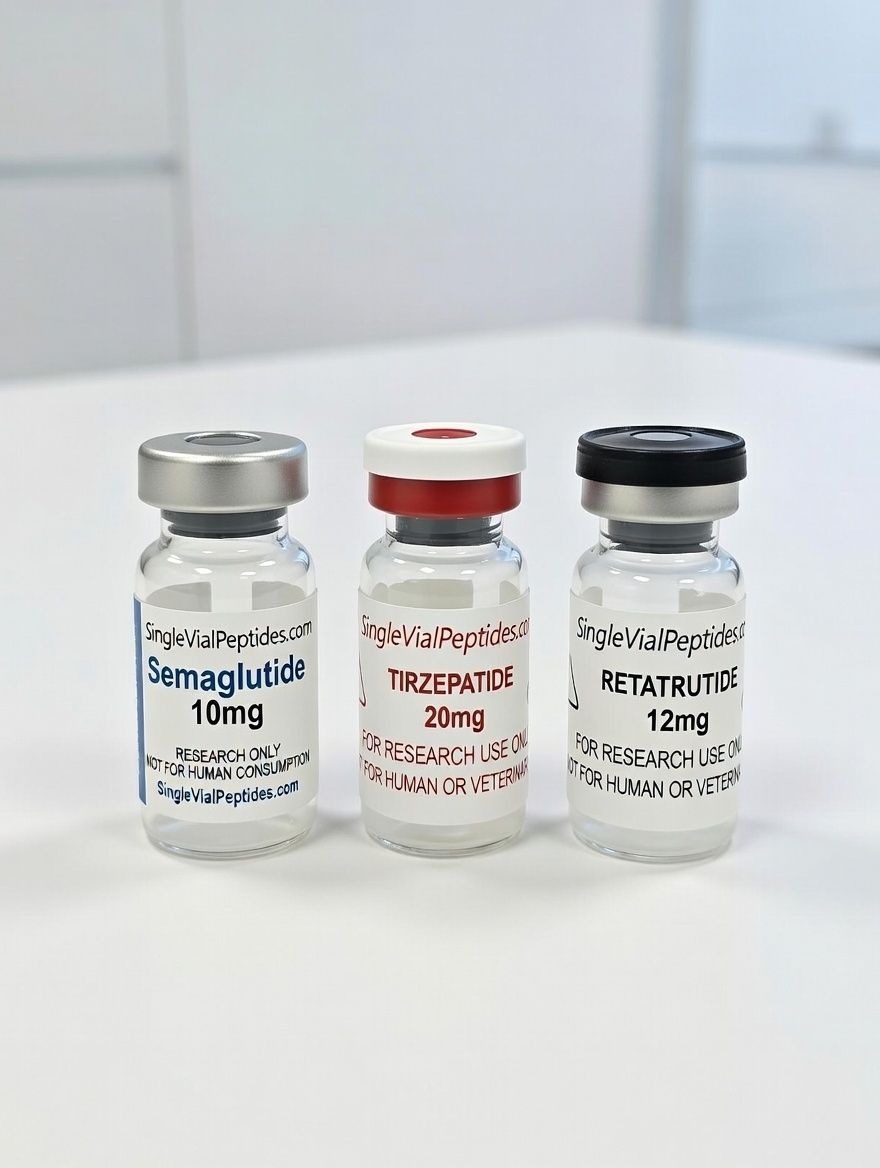
A person on a video says a number. Ten. Thirty-one. Six. That number is not automatically the milligrams in your vial. Five different numbers show up on these bottles and on the supplies, and they do not turn into each other.
This page names them. It does not give a dose, and it does not describe how to mix or inject.
Milligrams, the weight on the vial
A milligram is a weight. The number on a research-vial label here is the labeled amount of dry material. A vial marked 10mg is a 10 milligram label. It is not a liquid volume and it is not a mark on a syringe. The fill can sit 10 percent under or over that sticker. The longer label note is how to read a research-vial label.
Milliliters, the volume of a liquid
A milliliter is how much liquid is there. People online say 0.1 mL as if that were an amount of peptide. It is an amount of liquid. How many milligrams are in that liquid depends on the strength of the liquid. The same 0.1 mL can hold different weights. That note is why 0.1 mL from a video is not a dose.
Units, the marks on one kind of syringe
MedlinePlus, reviewed July 21, 2024, says this about insulin, not about a research vial: "Standard insulin contains 100 units in 1 milliliter (mL). This is also called U-100 insulin. Most insulin syringes are marked for giving you U-100 insulin. Every small notch on a standard 1 mL insulin syringe is 1 unit of insulin." The same page says more concentrated insulins exist, including U-500 and U-300, and that the type of insulin should match the type of syringe. Giving an insulin injection.
That page is an insulin lesson for a prescribed medicine. This shop does not copy its steps. The one fact used here is the ruler. On a syringe that says U-100, 100 units equals 1 mL. Ten units is 0.1 mL of volume. The lines are not milligrams of peptide. If the barrel does not say U-100, do not use that sentence. The longer ruler note is units are a ruler.
When a video says "I do 10 units," the usual meaning is this mark. It is their mark, on their liquid. It is not your milligrams. Ten units on a video is not your milligrams.
Gauge, how thick the needle is
Gauge is a thickness scale for the outside of a needle. It comes from wire making. The Birmingham gauge page says smaller gauge numbers indicate larger outer diameters, and that in medicine the gauge is widely used for the outer diameter of hypodermic needles. Birmingham gauge.
A higher gauge number is a thinner needle. A lower gauge number is a thicker needle. The 31 on a syringe pack is this scale. It is not 31 milligrams, and it is not 31 units.
The pack in this shop is syringes, 31 gauge, 6mm, ten in a pack, for $5. The listing says the gauge and the length. It does not say the barrel is U-100, and it does not say how many milliliters the barrel holds. Those words, if they are anywhere, are printed on the syringe.
Millimeters, how long the needle is
A label that pairs the two looks like the examples on that same gauge page, a gauge number beside a length. Six millimeters is a length. It is how long that needle is. It is not a dose, and it is not a unit count.
What to do with a number from a video
Ask which of the five it was.
- A milligram belongs on a vial label. It is a weight.
- A milliliter is a volume of liquid.
- A unit, on a barrel that says U-100, is a place on that volume ruler. One hundred units is 1 mL.
- A gauge is how thick the needle is.
- A millimeter on that pack is how long the needle is.
The mix calculator divides the milligrams you type by the milliliters you type. It then lists the milligrams in 0.1 mL, 0.5 mL, and the other common volumes at that strength. It will not pick a dose, and it will not decide that a video was talking about your vial.
If a prescriber or a pharmacist already gave you a number, their label wins. If the medicine in your hand is a finished Lilly pen, the pen has Lilly's own instructions: lilly.com.
Vials on singlevialpeptides are research material, for adults 21 and older, not for people or animals. A syringe in the catalog is not an instruction to use it on a person or an animal.
Viales de investigación. 21 años o más. No es para personas ni animales. No es consejo médico.