 Single Vial Peptides
What papers say about GHK-Cu
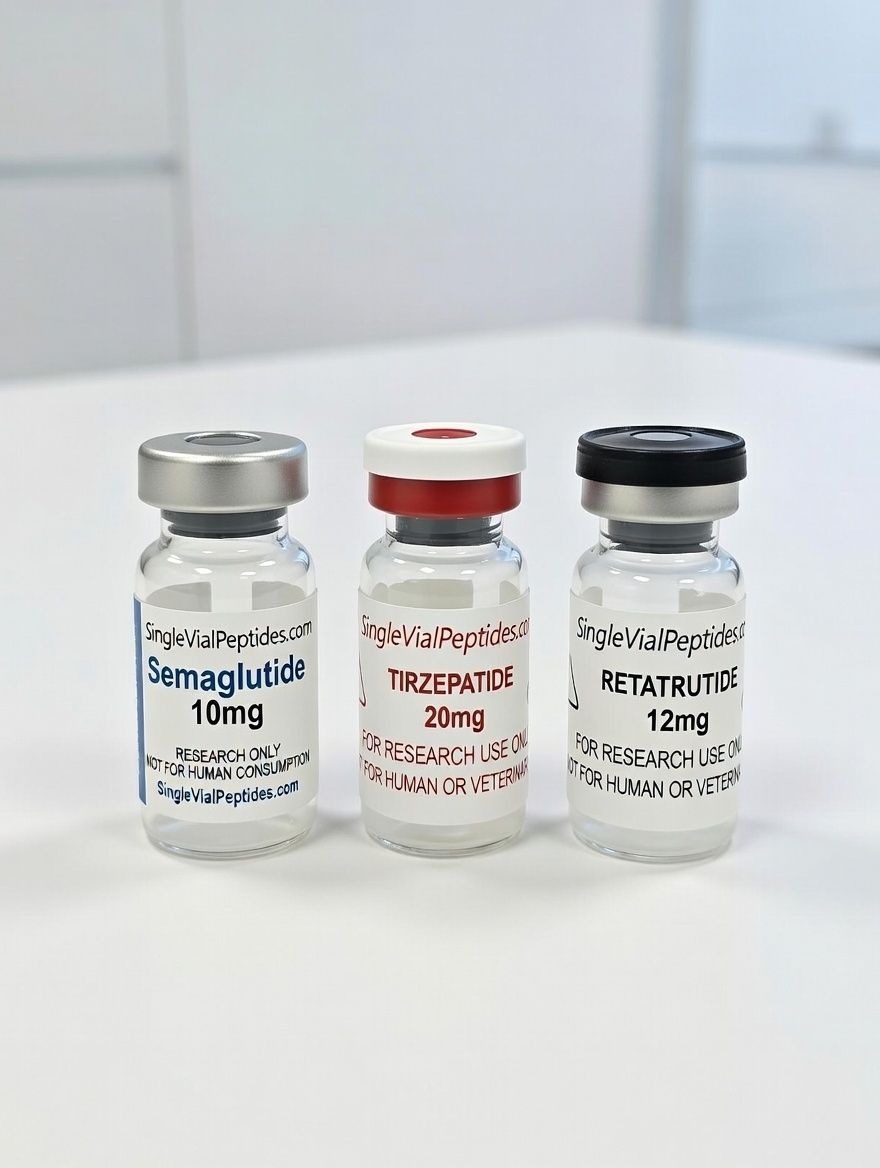
This shop does not claim what GHK-Cu does. The sentences below are taken from papers opened for this note. A line that is not on one of those pages is not repeated here. Nothing in this note is a protocol, a dose, or medical advice.
GHK-Cu is the copper peptide in these papers
Loren Pickart and Anna Margolina, in a 2018 review in the International Journal of Molecular Sciences, call GHK-Cu a copper-binding peptide and give the sequence as glycyl-L-histidyl-L-lysine. They write that it "is a small, naturally occurring tri-peptide present in human plasma that also can be released from tissues in case of an injury." They date the discovery to 1973 and say that, since then, GHK-Cu "established itself as a powerful protective and regenerative ingredient, which is currently widely used in skin and hair products." That is their characterization of the ingredient in skin and hair products. It is not a result from this shop, and it is not a statement about a dry research vial.
The same review describes the experiment it credits with the discovery. Plasma from young people, added to liver tissue from older people, caused the older tissue "to produce proteins more characteristic of younger individuals." The citation on that sentence is Pickart's 1973 PhD thesis at the University of California, San Francisco: "A tripeptide in Human Serum That Promotes the Growth of Hepatoma Cells and the Survival of Normal Hepatocytes." The thesis was not opened for this note. The 1973 description here is the review's.
The authors' address on the paper is R&D Skin Biology, Bellevue, Washington. The paper says the authors declare no conflict of interest. It is still a review from the group that has written about this peptide for decades.
They also give a blood level. "At age 20, the plasma level of GHK is about 200 ng/mL," which they equate to about 10−7 M, "and by the age of 60, it declines to 80 ng/mL." Those figures are the review's description of peptide already in human plasma. They are not a target, and they are not a dose.
Copper peptide work in fibroblast culture
The collagen result people cite is older, and it is a cell-culture paper. Maquart and colleagues, FEBS Letters, 1988, is the abstract opened here. The 2018 review's reference list names Pickart among the authors of that paper. The abstract says glycyl-L-histidyl-L-lysine "is a tripeptide with affinity for copper(II) ions and was isolated from human plasma," and that the peptide "appears to play a physiological role in wound healing." The result sentence is specific: "We report the stimulating effect of GHK-Cu on collagen synthesis by fibroblasts. The stimulation began between 10(-12) and 10(-11) M, maximized at 10(-9) M, and was independent of any change in cell number."
That is a fibroblast-culture experiment. The molar numbers are concentrations in dishes of cells. This page does not convert them into any other amount.
The abstract adds that a GHK triplet is present in the alpha 2(I) chain of type I collagen, and suggests the tripeptide "might be liberated by proteases at the site of a wound and exert in situ healing effects." The 2018 review retells that idea: in the 1980s, Maquart's group proposed GHK as an early signal for skin repair, released when injury turns on proteolytic enzymes. The review says later experiments found stimulation of collagen, selected glycosaminoglycans, and the small proteoglycan decorin, and modulation of metalloproteinases and the inhibitors that hold those enzymes back. That is the review summarizing those papers. It is a description of matrix turnover in the work they cite, not a promise attached to a vial.
What that review says about skin
On gene expression, Pickart and Margolina use the Broad Institute Connectivity Map. At their cutoff, "the number of human genes stimulated or suppressed by GHK with a change greater than or equal to 50% is 31.2%." They write that expression went up in 59 percent of that set and down in 41 percent. The percentage belongs to that analysis. It is not a property of a label.
The cosmetic section is topical creams and serums, as the review tells it, not a study of this dry vial. A facial cream used for 12 weeks by 71 women with photoaging is reported to have increased skin density and thickness and reduced laxity, fine lines, and wrinkle depth. An eye cream used for 12 weeks by 41 women is described as better than placebo and a vitamin K cream on lines and skin thickness. Thigh skin treated for 12 weeks is described as improved collagen production in 70 percent of the women on GHK-Cu, against 50 percent with vitamin C cream and 40 percent with retinoic acid. A randomized, double-blind passage describes GHK-Cu in a nano-lipid carrier for 8 weeks: wrinkle volume down 31.6 percent versus Matrixyl 3000, and, versus a control serum, wrinkle volume down 55.8 percent and wrinkle depth down 32.8 percent. Those numbers are the review's account of creams on skin. They are not instructions.
Animal experiments in the same review
A section titled "Animal Studies Confirm Wound Healing Activity of GHK" describes animal experiments: rabbit wounds, a collagen dressing in healthy rats and in diabetic rats, ischemic open wounds in rats, and severed nerves in a rat placed in a collagen tube. In the healthy-rat dressing experiment, the review says collagen increased ninefold. In the rat nerve experiment, as the review summarizes Ahmed and colleagues, it reports more nerve outgrowth and more nerve growth factor than in the control. This note does not repeat doses or convert an animal amount into a human amount.
The review also says GHK-Cu "is very sensitive to breakdown by carboxypeptidase enzymes," and that fluid on some wounds breaks GHK down. That is a caveat about wound fluid. It is not a handling note for a sealed research vial.
The vial on this shop
GHK-Cu 50mg is one research vial. The price is $35. Two vials are $60. Five are $120. Purity is at least 99 percent. Fill is within 10 percent of the label, so a vial labeled 50mg is filled from 45mg to 55mg. Sale is to adults 21 and older. The material is for laboratory research. It is not for people or animals. This shop is not a pharmacy. This page is not medical advice.
GLOW and KLOW are nicknames for blends in one vial. They are not another name for the copper peptide. The single peptide is the vial linked above.
The July 2026 vote is quoted on its own page
MedPage and Pharmacy Times printed the committee tallies. Those tallies, and the lines saying a recommendation is not an approval, are in The July 2026 peptide vote is not an FDA approval. This page does not turn that vote into a shop claim.
What CNN and the other outlets wrote
Scientific American says Reddit posts "rave about GHK-Cu and KPV" for "scar-free, youthful skin and thick hair," and that people claim GHK-Cu "increases wound healing, decreases scarring and helps regenerate collagen." The same April 18, 2026 piece says GHK-Cu "is an FDA-approved ingredient in topical antiaging cosmetics" and "is currently banned as an injectable because of safety concerns, such as the risk of immune reactions caused by impurities." Scientific American. That injectable line is the magazine's as of April 2026. The Guardian's April 4 explainer says GHK-Cu "is purported to have anti-ageing effects." The Guardian. CNN's April 13 feature quotes a clinic executive calling a copper peptide a messenger that might "regenerate cellular levels of the skin," and quotes a surgeon who told CNN she has prescribed GHK-Cu with BPC-157 and TB-500 "to promote healing." CNN. Those are their claims. The roundup is What CNN, Fox, and the other outlets wrote. GHK-Cu was not one of the seven names on CNN's July vote list.
Sources
- Pickart L, Margolina A. Regenerative and Protective Actions of the GHK-Cu Peptide in the Light of the New Gene Data. International Journal of Molecular Sciences, 2018. Full text
- Maquart FX, et al. Stimulation of collagen synthesis in fibroblast cultures by the tripeptide-copper complex glycyl-L-histidyl-L-lysine-Cu2+. FEBS Letters, 1988. PubMed abstract
Research vials. 21 and older. Not for people or animals.
Forschungsvials. Ab 21. Nicht für Menschen oder Tiere. Kein medizinischer Rat.