 Single Vial Peptides
What papers say about BPC-157
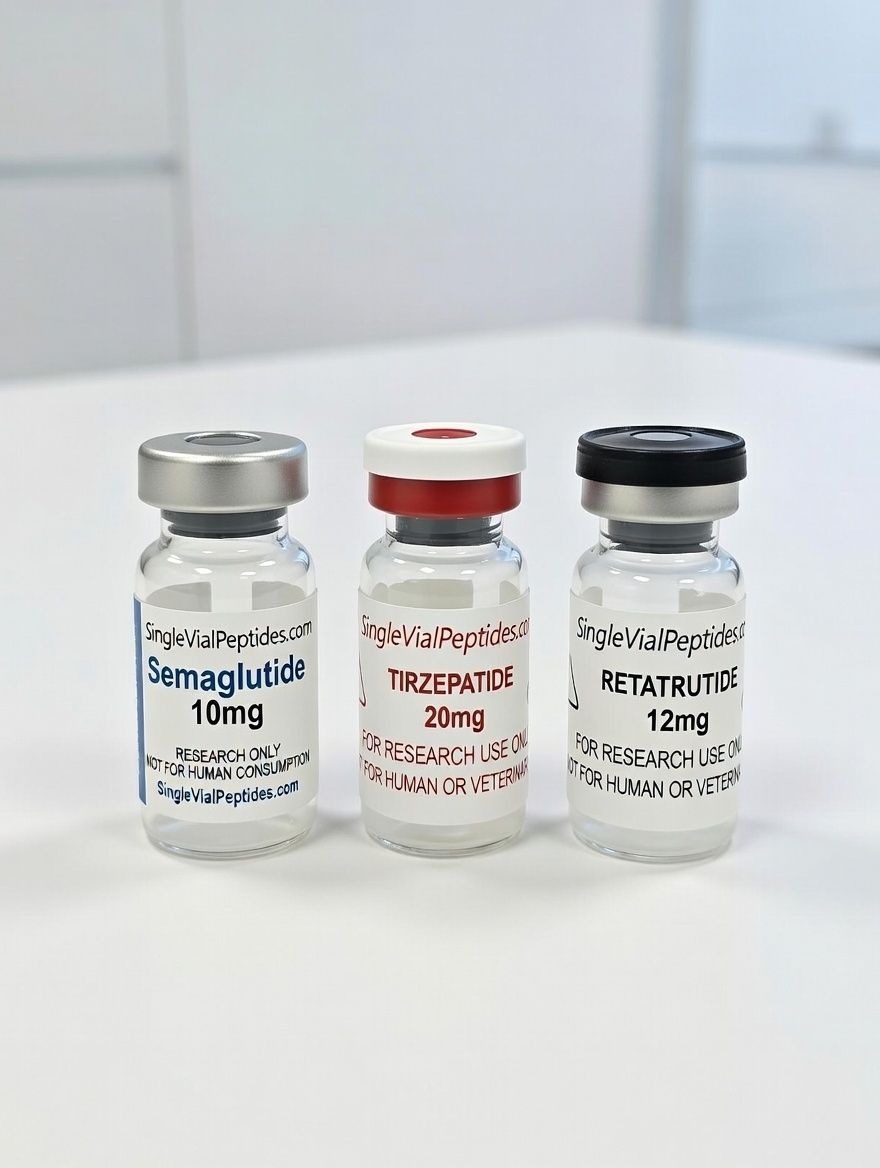
This note quotes papers and FDA records. It is not a finding by this shop. The vials sold here are not the material in any study named below.
BPC-157 in a published review
In 2011, Predrag Sikiric and colleagues reviewed the compound in Current Pharmaceutical Design. The abstract opens with this sentence:
"Stable gastric pentadecapeptide BPC 157 is an anti-ulcer peptidergic agent, safe in inflammatory bowel disease clinical trials (GEPPPGKPADDAGLV, M.W. 1419, PL 14736) and wound healing, stable in human gastric juice and has no reported toxicity."
That is the authors' sentence. This shop does not adopt "safe" or "no reported toxicity." The parentheses are the identity this page uses: they call it a pentadecapeptide, print GEPPPGKPADDAGLV, give a molecular weight of 1419, and use the code PL 14736. Pentadecapeptide means fifteen amino acids. A 2012 review by the same group in Current Medicinal Chemistry repeats that sequence and weight, and says the inflammatory-bowel work under PL 14736 had been "so far only tested in clinical phase II." A phase named by authors is not an approval.
What one rat experiment is said to have shown
The 2011 abstract includes this account of work in rats:
"In rat esophagitis and failed function of both lower esophageal sphincter (LES) and pyloric sphincters (PS), BPC 157 increased pressure in both sphincters till normal and reduced esophagitis."
That sentence is the review's description of a rat experiment. It is not a result in people, and it is not a method. The next sentence says that, in healthy rats, the material "may decrease (PS) or increase (LES) the pressure in sphincters."
What FDA wrote about BPC-157
FDA's briefing for the Pharmacy Compounding Advisory Committee meeting of July 23–24, 2026, covers "BPC-157-Related Bulk Drug Substances (BPC-157 (free base) and BPC-157 acetate)." The introduction says: "BPC-157 is also known as Bepecin or PL-14736, which is a peptide that is reported to be comprised of 15 amino acids."
The chemistry section says: "BPC-157 (free base) is reported to be a pentadecapeptide fragment of BPC (H-Gly-Glu-Pro-Pro-Pro-Gly-Lys-Pro-Ala-Asp-Asp-Ala-Gly-Leu-Val-OH) that has been found in gastric juice as shown in Figure 1. The molecular formula of BPC-157 (free base) is C62H98N16O22, and its molecular weight is 1419.5 g/mol."
That string is the 2011 sequence, written as amino-acid names. FDA also says BPC-157 "is a pentadecapeptide fragment of the BPC protein originally isolated from human gastric juice," citing Sikirić and colleagues, 1993. Those sentences are about the literature, not about a vial from this shop.
FDA separates two forms: "BPC-157 acetate and BPC-157 (free base) are different active pharmaceutical ingredients and hence are considered different BDSs." This shop's listing uses the name and a milligram figure. It does not claim to be the free base, the acetate, or a lot from a paper.
On status, the briefing says: "There is no applicable United States Pharmacopeia (USP) or National Formulary (NF) drug substance monograph for BPC-157 (free base) or its acetate form, and neither is a component of an FDA-approved drug."
FDA evaluated both for ulcerative colitis. Its conclusion: "There is a lack of evidence to support the effectiveness of BPC-157 (free base) and BPC-157 acetate as a treatment for UC." It adds that "the data available do not support the use of BPC-157 for the treatment of UC," and that approved drugs are already indicated for that disease. The recommendation says the criteria "weigh against them being added to the 503A Bulks List," and: "Accordingly, we propose not adding BPC-157 (free base) or BPC-157 acetate to the 503A Bulks List."
FDA also writes that, as a 15-amino-acid peptide, BPC-157 may pose a significant risk for immunogenicity. The cover sheet says a final determination would wait until the advisory-committee process was finished. This note does not report a vote. No vote record was opened.
The Federal Register notice
The Federal Register notice of April 16, 2026 (91 FR 20465) states one condition for the section 503A exemptions. The pharmacist or physician must use bulk drug substances that comply with an applicable USP or National Formulary monograph, if one exists; or, if no monograph exists, are components of drugs approved by the Secretary; or, if there is no monograph and the substance is not a component of an approved drug, appear on the 503A Bulks List issued by regulation.
The notice says that on July 23, 2026, the committee would discuss "BPC-157 (free base)/BPC-157 acetate" for inclusion on that list. It announces a meeting. It is not a final rule adding BPC-157 to the list.
BPC-157 on the WADA list
The World Anti-Doping Agency Prohibited List page places BPC-157 in section S0, Non-approved substances, prohibited at all times. The class covers "any pharmacological substance which is not addressed by any of the subsequent sections of the List and with no current approval by any governmental regulatory health authority for human therapeutic use," and names BPC-157 among the examples. That is a sport rule, not medical advice.
The BPC-157 vial this shop sells
Separate from those quotations, this shop sells a BPC-157 5 mg research vial for $35, or two for $60, at singlevialpeptides.com/vial/bpc-5mg. Purity is at least 99 percent. Fill is within 10 percent of the labeled weight. Buyers must be adults 21 and older. The material is not for people or animals. This shop is not a pharmacy, and this page is not medical advice.
TB-500 is a different substance in FDA's briefings. A vial that prints both names is a shop label, not a third molecule defined by the papers quoted here.
The July 2026 vote is quoted on its own page
MedPage and Pharmacy Times printed the committee tallies. Those tallies, and the lines saying a recommendation is not an approval, are in The July 2026 peptide vote is not an FDA approval. This page does not turn that vote into a shop claim.
What CNN and the other outlets wrote
The news quotes are collected in What CNN, Fox, and the other outlets wrote. On BPC-157, the lines those pages actually printed are claims, not a shop result.
Reuters, September 15, 2026, says social posts claim "muscle growth and injury recovery not backed by scientific testing," and that BPC-157 "is often taken together with" TB-500 as the "Wolverine stack." Reuters. CNN's July 22 piece lists the docket's proposed use as ulcerative colitis, and prints an 8-6 vote, with one abstention, for the free-base form and again for the acetate form. CNN. Fox quotes Alex Tatem claiming BPC-157 "can help facilitate healing after injury" and has "been shown in multiple studies to be incredibly safe when administered," and on the same page quotes Marc Siegel: "I am not convinced the data is fully there yet." Fox News. The Guardian's April 4 explainer says a U.S. review found tendon and muscle findings "largely unvalidated in human trials." The Guardian. The Associated Press, via CNN on November 15, 2025, quotes Eric Topol: "None of them are proven." CNN.
Sources
- Sikiric and colleagues, Current Pharmaceutical Design, 2011. https://pubmed.ncbi.nlm.nih.gov/21548867/
- Sikiric and colleagues, Current Medicinal Chemistry, 2012. https://pubmed.ncbi.nlm.nih.gov/22300085/
- FDA briefing, BPC-157-related bulk drug substances, July 23–24, 2026 meeting. https://www.fda.gov/media/193343/download
- Federal Register, April 16, 2026, 91 FR 20465. https://www.govinfo.gov/content/pkg/FR-2026-04-16/pdf/2026-07361.pdf
- World Anti-Doping Agency, Prohibited List. https://www.wada-ama.org/en/prohibited-list
- Shop listing: https://singlevialpeptides.com/vial/bpc-5mg
Research vials. 21 and older. Not for people or animals.
Výzkumné lahvičky. Od 21 let. Není pro lidi ani zvířata. Není to lékařská rada.