 Single Vial Peptides
Hollywood named a peptide. San Francisco started companies.
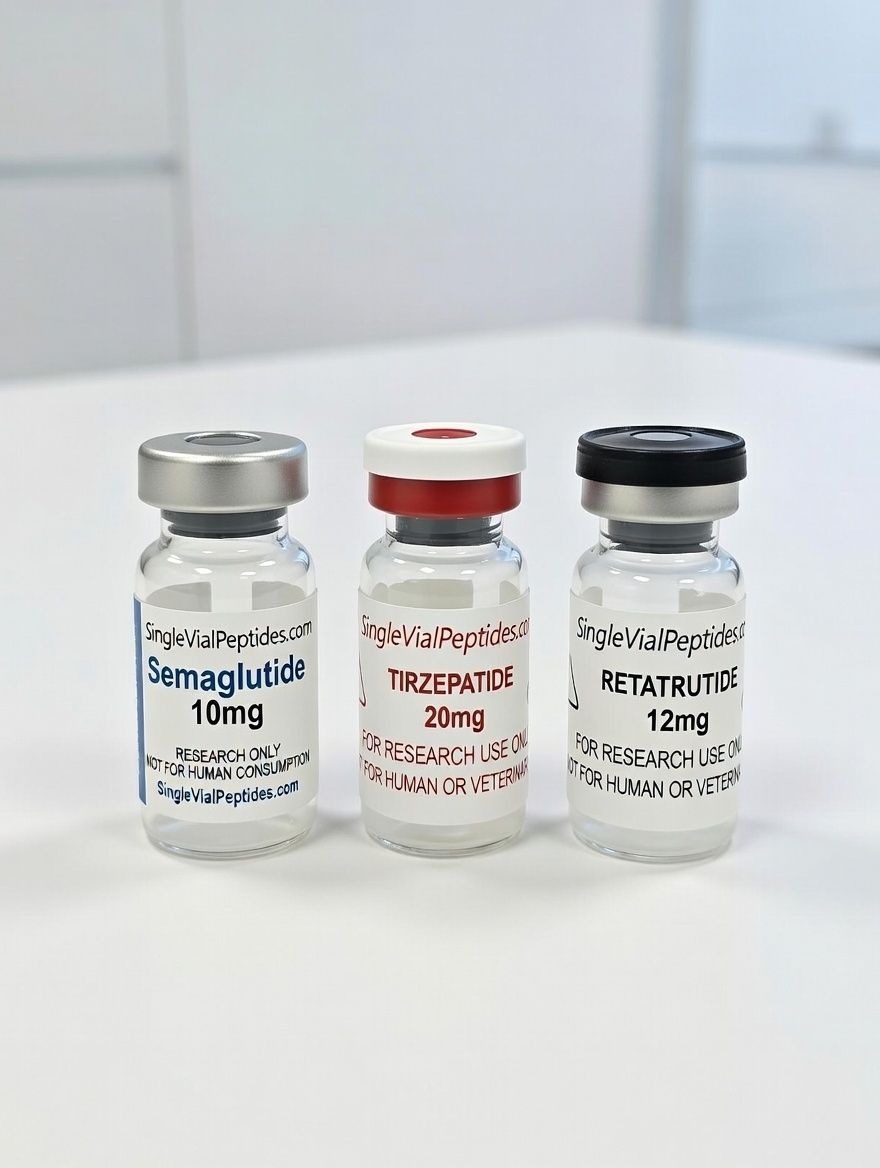
Hollywood and San Francisco spent 2026 on the same word, in different rooms.
The Hollywood Reporter quoted Hailey Bieber on GHK-Cu. Business Insider and The San Francisco Standard reported a house meeting in Twin Peaks, then a set of companies taking money and taking meetings. ProPublica reported two hospitalizations after peptide injections at a Las Vegas conference. This note quotes those four pieces. A quote is not a method.
This shop sells single research vials. Buy one or as many as you like. It is not the club, the telehealth startup, or the clinic in the glass-case story. Adults 21 and older. Laboratory research only. Not for people or animals. Not a skin routine, a training plan, or a longevity stack.
What The Hollywood Reporter printed
James Hibberd, July 15, 2026, Celebs Are Injecting Copper to Look Younger. Can It Backfire?. The story ran in the magazine's July 2026 issue, "The New Face of Hollywood."
His definition is short. GHK-Cu is three naturally occurring amino acids bound to a copper ion.
Hailey Bieber, who has the Rhode skin-care company, is the celebrity sentence. Hibberd quotes what she told Interview magazine: "I think there are certain peptides you can take that are really good for hair, skin and nails, like GHK-Cu, which is the copper peptide, something I take." Interview itself was not opened for this note. The line here is Hibberd's quotation of it.
New York dermatologist Dr. Anetta Reszko told him the popularity started "in the circle of biohackers, bodybuilders and people looking for faster [skin healing] recovery, but also in esthetic circles." She said it "stimulates new collagen elastin," that it has been shown to improve skin texture, including pore size, and that it seems to speed recovery after laser resurfacing and microneedling. Those are her claims to the magazine. The studies behind them were not opened for this page.
Hibberd then describes a gray market. People buy injectable GHK-Cu from unregulated online vendors, sold as "research chemicals." One variation he names is the "GLOW protocol," GHK-Cu combined with BPC-157 and TB-500. He writes that the cost usually runs about $70 to $300 a month, depending on the source, and that gray-market GHK-Cu can cost about $50 for a month's supply. Those figures are his report of a month of use. They are not a price on this shop, and they are not a dose.
Reszko's line on creams, so the absorption claim stays hers: "On average, probably 5 to 10 percent of the product which you apply to the surface of the skin goes into the skin." She says breaking that barrier increases absorption dramatically. The sentence is not a set of steps.
The piece then uses the nickname "copper uglies" for skin that looks worse. One Reddit user is quoted: "The best way I can describe it is that my skin looks kind of like a leather handbag — stiff, textured, and just different." Hibberd writes that it is unclear whether the nickname is a real effect or an internet myth. He cites a 2018 analysis and says its conclusion was that the peptide's actions "appear to be health positive." This note did not open that analysis. His page does not name the authors.
His close is the line worth keeping in his wording. Don't experiment on yourself. Gray-market peptides, he writes, have been found to contain toxic heavy metals, "like arsenic and lead." That sentence is about the gray market as he describes it. It is not a lab report on any one seller, including this shop. Reszko says she has never had a "copper uglies" case in her practice. Then: "You don't know what's in the formulation." "And if you overdose on copper, you can actually get toxicity from it." "Not all copper peptides are created equal."
A Reddit user on the same page named a daily milligram amount. It is left off this page.
The GLOW vial here is 50mg GHK-Cu, 10mg BPC-157, and 10mg TB-500. Hibberd's protocol names those three ingredients. He does not print those milligrams. The blend labels are on Wolverine, GLOW, and KLOW. The paper note is What papers say about GHK-Cu.
The California Peptide Club, with two headcounts
Arielle Pardes, Business Insider, April 19, 2026, Inside San Francisco's Hottest Peptide Club. She dates the gathering to April 12 at AGI House, a mansion in Twin Peaks where people working on artificial general intelligence rent rooms. More than 100 people came. Another 300 were waitlisted. Julius Ritter, 24, president of the house, organized the California Peptide Club. She quotes him: "Creating the allure of getting invited to the house is actually one of the priorities."
Zara Stone, The San Francisco Standard, May 17, 2026, San Francisco startups are pushing a hot peptide summer. Her count for the inaugural California Peptide Club, at the same house, is around 110 people, mostly Gen Z and millennials, and six panelists. The photo caption calls Ritter the founder of the club. The story says he is president of AGI House and that he hosted the meeting. Both wordings stay. The two counts stay. This page does not average them into a third number. Pardes gives the Sunday as April 12. Stone calls it a recent Sunday.
Stone writes that the panel included Dr. Alexander Grinberg, who will be a physician on an $80,000 luxury longevity tour run by Xprize founder Peter Diamandis. Guests had cheese and sparkling water. Both reporters describe toga-clad mannequins. Pardes writes that the mannequins' hands held insulin syringes. Stone writes that the sashes were adorned with syringes. The prop is part of the reporting. It is not a diagram.
Pardes's scene-setting, which this note did not re-check by opening another interview or a search chart: "Joe Rogan takes peptides; so does Jennifer Aniston." She writes that in April, Google searches for "peptide" overtook "pickleball," and that "Chinese peptide dealer" had become a meme. Stone, in May, writes that searches for the term had overtaken pickleball, matcha, boba, and Labubu. Each comparison belongs to the outlet that printed it.
Stone's other celebrity sentence does not name a compound. "Country singer LeAnn Rimes gives herself daily shots." The peptide is not in that sentence. This page does not add one.
The Guardian's lines on Joe Rogan and the two-peptide Wolverine stack are already on the blend note. They are not repeated here.
What Ritter told them
Stone writes that Ritter had been a skeptic and then began injecting. His current protocol, she writes, includes retatrutide and BPC-157, available as "research use only." He claims the compounds fixed lagging energy and stalled gains in the gym. That claim is his. Friends ask where he buys. He will not say where. He has turned down influencer commissions from sellers. She writes that he is wary of steering people toward products he has not vetted.
Pardes prints an earlier account, also from him. Blood tests, he told her, put his testosterone "in the bottom one percent of men my age." He tried CJC-1295 and ipamorelin. She quotes the roommates mocking him for the injections. He called the results underwhelming. A later stack, BPC-157, SS31, ipamorelin, tesamorelin, and IGF-1 LR3, "made him feel great." That is one person describing five names together. It is not a result for any single name. SS31 and IGF-1 LR3 are in Pardes's sentence. This shop does not sell them.
Stone writes that retatrutide is still in Phase 3 trials at Eli Lilly, and that BPC-157 has had little research and is off-limits to prescribe, dispense, or compound. She writes that medical experts warn about quality that varies, dosing that is unclear, contamination, and almost no long-term safety data. She writes that most of these peptides arrive via China. The retatrutide record, as this shop has it, is Retatrutide is still not approved.
Pardes separates two legal piles. Insulin, and GLP-1 drugs such as Ozempic, are legal with a prescription. Most of the other names sit in a gray zone and are sold as research chemicals, usually from compounding pharmacies or from research labs in China. She writes that three days after the April 12 meeting, Health and Human Services Secretary Robert F. Kennedy Jr. announced he would reclassify a dozen peptides that had been barred, and she names BPC-157, Semax, and Melanotan II. That is her account of an announcement.
Stone, publishing a month later, describes what she could see had followed a February appearance by Kennedy on The Joe Rogan Experience. He criticized the FDA's "illegal" classification of 19 peptides as unsafe and said he planned to make some of them more accessible. Two months after that appearance, she writes, the FDA removed 12 peptides from category 2, its do-not-compound list, and scheduled a July review. Her next sentence is the one to hold onto: "Legally, nothing meaningful has changed." The hearing is covered in The July 2026 peptide vote is not an FDA approval. An announcement, a list edit, and an advisory vote are three different events in these pieces. None of them is an approval of a research vial.
Inside the room
Pardes writes that Ritter opened by saying it was not an injection party. About half the room, about 50 people, raised a hand for having taken peptides. Asked who had injected a research-only peptide labeled not for human consumption, every one of those hands stayed up.
One woman told Pardes she was too scared to inject GHK-Cu and had put a topical version in her moisturizer. Another had started NAD+ injections and said, "It's actually kind of fun." NAD+ is not a peptide. That is the shop's own line, on the NAD+ page. Pardes is quoting a guest at a party.
The speakers she names: Awais Spall, a functional-medicine practitioner, said peptides had spared him from opioids for muscle pain. Alex Ellis, who runs an event called BioHack Miami, called Semax "an absolute game-changer." Grace Liu, who prescribes stacks to athletes and business people, named Selank and Epitalon. Pardes writes that Liu shared protocols she had designed. Those protocols are not on this page. Semax, Selank, Epitalon, and Melanotan II are not vials here.
One attendee told Pardes he had built a stack from a doctor's advice and later learned the doctor was an ophthalmologist.
Between talks there was a quiz. The prize was a mini fridge, reconstitution syringes, injection syringes, and alcohol pads, with the peptides sold separately. The winner worked in peptide manufacturing and did not want it. The runner-up founded a property-technology startup. The list is what Pardes says was in the prize. It is not a set of directions.
A volunteer then demonstrated an injection of retatrutide. Dozens of people filmed it. Pardes describes the demonstration as a series of steps. The steps are not repeated here. Ritter told her, in the days after, "I think we did many things well, but what we didn't do, we didn't take a step back from the accelerationist mindset. Like, hey, what are some of the risks?"
He said he plans to hold the club monthly and is "trying to figure out the legality" of offering injections at future nights. "People actually like the syringe, because it feels like you're hacking yourself." An early-stage venture capitalist with a torn ACL told Pardes that next time he would inject BPC-157, and that he would not be so cautious. That is a conversation at the end of a party. It is not a recovery plan. Pardes also writes that peptides can cause nausea or skin irritation in the short term, that a few have been linked with cancer risk in the long term, and that a vial of unknown origin is hard to trust for purity or concentration. Those are her cautions. They are not a protocol either.
Stone's later look at his calendar: a build-your-own meetup, an event about using AI to modify GLP drugs, a genome-sequencing event, and possibly an IV drip night. He is considering a "performance peptide welcome kit" for people new to the city, with a mini fridge, syringes, and maybe samples, if the legal side can be sorted. In the same story he says, "It's dangerous when you try to shortcut taking care of your natural biology," and, "I love being the guinea pig. It's so exciting. SF is so back."
The companies, and the people who already had the money
Stone's deck states the bet: "Despite medical concerns and no FDA approval, startups are betting big on gray-market peptides." She writes that in San Francisco the question had moved from "What are you taking?" to "What are you building?"
The earlier Standard piece, September 30, 2025, by Margaux MacColl, Rya Jetha, and Zara Stone, is a lifestyle survey with a blunt headline, Semen, sleep, syringes: The Tech Bro 2.0 manual to living forever. This note uses the peptide section of it.
They write that Superpower hosted a weekly "Peptide Friday." Leaders handed out alcohol wipes and peptide syringes. Thymosin alpha-1 was a crowd favorite. Max Marchione, the 25-year-old cofounder: "It started as a joke, but it was popular so we continued it." He spends $1,000 on his monthly stack. "None are FDA approved." "I get them from a Chinese peptide dealer," and the shipments arrive with "research use only" labels. "All that matters is if I increase performance, even if it introduces a bit of short-term risk." The writers' paraphrase of what fans say, which is not a trial: people rave about BPC-157 for tendon healing, GHK-Cu for skin, and Semax for focus.
Michael Carter, who started Finnrick to grade vials for purity, told them: "Everyone has a peptide guy. What people need is transparent information so they can make their own decisions." Finnrick is his project. It is not this shop, and this page does not claim Finnrick has graded these vials.
By the May 17, 2026 story, Stone writes that the Fridays had been scrapped. They did not match "the clinical gravity" of the message the company wanted. Marchione: "Now we do collagen peptide Fridays," which is a legal powder in water. Peptides left the communal fridge. A dedicated fridge, she writes, "will go on a plinth."
In April, the same May story says, he posted a waitlist for Superpower Peptides and called it the start of "the peptide era." Superpower was supplying only approved peptides for the moment. "We're just waiting for the FDA." "Our investors were very anti-peptide four months ago. Now they think we're well positioned to be the peptide company in the U.S." Stone writes that the company plans nasal-spray versions of modified BPC-157, semaglutide, and other compounds, with the Australian startup Tetratherix. A plan for a modified spray is not a vial on this counter. This shop is not Superpower.
The named checks in that May piece:
- NoHo Labs is in San Francisco. Matt Mazzeo, a former general partner at Coatue, founded it. Stone writes that it raised $16 million and is backed by Elad Gil and by 8VC, the fund started by Palantir cofounder Joe Lonsdale. She writes that NoHo had recently removed gray-market offerings from its site.
- System Labs is a San Francisco telehealth company. It told The Standard it works with clinicians in every state and sticks to legal compounds for now.
- Stack was still in beta.
- The Protocole is in New York. Stone writes that it raised a $6 million seed round led by Rare Capital, and that its social-media pitch is the middle between "sketchy internet sites" and expensive longevity clinics, with physician oversight and peptides from an FDA-regulated pharmacy.
- Vril Peptides launched a site in February. The founders had worked in crypto and in startup growth. They declined to be named, citing "serious issues" if they were identified. Their sentence, as she quotes it: "There's an epidemic of young, ill people who need to put their health in their own hands in order to heal themselves." That is their pitch.
On the street, in March, Dr. Brett Florie opened the 56th location of The Hydration Room in Cow Hollow. He is an anesthesiologist and the founder of that IV-clinic chain. Stone describes a glass case of gray-market vials, including one labeled "BPC-Wolverine + KPV" and another, thymosin alpha-1, marketed for immune support. Florie told her, "It's gonna be approved very shortly," and that patients have to get bloodwork first. Dr. Jordan Shlain, founder of the concierge practice Private Medical, told Stone what he thinks that bloodwork is worth: "The only reason why they're asking you to do a blood test is that if something goes wildly wrong, you know that it went wrong. There's no blood test to show you that it went right."
Shlain's line on the category is earlier in the piece. "There's no transparency; there's no intellectual honesty here." He warned that untested peptides could trigger "potentially irreversible" autoimmune reactions. "I will change my point of view when a proper trial [shows] that this thing has a benefit." "Right now, it's just theater."
Uma Chalik, an investor at Torch Capital, told Stone she takes monthly meetings with peptide pharmacies and with "business in a box" platforms aimed at med spas. "Versus crypto, I think peptides are here to stay. It's a movement." She predicts peptide bars in major cities. The prediction is hers.
Garri Zmudze of LongeVC is the investor in the same article who declines the category. "We don't look at [peptides]. There is no IP." "I don't think it's really good to do experiments on yourself."
The lawyers in the piece are the counterweight. David Holt of Holt Law told Stone he gets five to 10 calls a day from people who want into the market, and that they experience him as "the buzzkill guy." "The business is ready and waiting," he said. The websites, in his account, are not updated yet. On investors, his downside is specific. They "would have a pretty good buffer when it comes to criminal and even civil exposure." "But financially, it could all just be gone, just like that." Jesse Dresser, at Frier Levitt, called it "just like the California gold rush," and said founders are "banking on the fact that no one is going to enforce it when it's going to be legal tomorrow."
Patricia Zettler, a law professor at Ohio State and a former HHS counsel, is the quote for the label itself. "There's the law on the books, and then there's the law as it's enforced, and we're not seeing a lot of enforcement." Much of the market, she said, is "pretty clearly running afoul" of FDA rules. A "research use only" label is "not a slam-dunk 'get out of FDA free' card."
Stone writes that since December the FDA had sent seven warning letters to peptide companies. One of them went to Pink Pony Peptides, which was still operating. The Standard notes that the singer Chappell Roan is not affiliated with that company. HHS did not answer the paper's questions about sales or enforcement. It pointed to the July meeting.
Peter Koshland teaches clinical pharmacy at UCSF and runs Koshland Pharm in the Financial District. He told Stone his staff had been taking calls from doctors about BPC-157 and other unapproved peptides. "Research-grade chemicals are basically all that's available." "I would lose my license if I was to compound with them and give them to a patient." If a green light arrived tomorrow, he said, he still could not dispense the research chemical. "There is no way to just Sharpie that with some testing." "The level of political pressure coming from above to the FDA for these specific medications is unprecedented." "We're all holding our breath a little bit and just hoping that nobody gets hurt."
Scott Brunner, CEO of the Alliance for Pharmacy Compounding, told her a pharmaceutical-grade supply line would take three to nine months. His comparison for the current market: "This isn't heroin. We don't have bodies in the street."
Las Vegas is the risk the San Francisco host cited
Pardes writes that Ritter was worried about what a bad night would do to the club's name, and she points at the prior summer's Revolution Against Aging and Death Festival in Las Vegas. The story she links is ProPublica's investigation of the peptide injections at that festival. The text opened here has no byline and no publication date on the page. It does carry a correction dated March 9, 2026. The injections it describes happened on July 13. Pardes, on April 19, 2026, places the hospitalizations in the previous summer. This note does not invent a publication day.
ProPublica's account: at least two women, a 38-year-old from California and a 51-year-old from Nevada, left in ambulances after peptide injections at a booth. Both were hospitalized in critical condition and needed ventilators. Both were recovering. The police report, as the investigation describes it, included swelling tongues, trouble breathing, and rising heart rates. One woman was intubated. The other lost muscle control in her neck and could not open her eyes or speak with the doctors. The Southern Nevada Health District and the Nevada Board of Pharmacy were investigating. Police had said as many as seven people might have been hospitalized. Detectives could not confirm anyone beyond the two. Investigators were looking at infection, contamination related to the injections, or the medication.
The booth was run by Kent Holtorf, a Los Angeles physician specializing in what the story calls age-reversal therapies. He is licensed in California. He is not licensed in Nevada. He told ProPublica he is cooperating, and that "almost assuredly it will come out that it was not the peptides." He said an artificial-intelligence app produced a 57-page report that, in his telling, made the peptides an impossible cause. He would not say what the report blamed. "I don't think it was the peptides, but I don't want to try and push the blame and say it wasn't us." He called the outcome "horrific" and "unacceptable," and said he was "terribly sorry." He said he had hired a Nevada-licensed practitioner, that he did not personally write prescriptions or give the therapies, and that he "knew what was going on but was not hands on." He said six patients received peptides. James Strole, who organizes the festival, said Holtorf provided therapies to 60 people, that it was not clear the illnesses came from that booth, and that nothing similar had happened in ten years of the event. A ticket cost more than $400.
David Wuest, executive secretary of the Nevada Board of Pharmacy: "In order to practice medicine in the state, you must be licensed."
Dr. Amy Gutman, a Florida emergency physician who had spoken at the festival, told ProPublica that any medical treatment can have a fatal side effect, including one that looks benign, and that a hotel is a poor place to discover that. The symptoms sounded to her like an allergic reaction.
The two women received different mixtures. Each mixture included at least one component the FDA describes as a significant risk when it is compounded. ProPublica notes that the FDA has approved dozens of peptide drugs for uses such as cancer, obesity, and diabetes, and that anti-aging peptide therapies are largely compounded and have not been reviewed by the FDA for that use. The agency has found "significant safety risks" with at least 18 of the popular peptide components used in compounding. The story does not print a recipe. This page does not add one.
Holtorf told police, ProPublica writes, that the peptides came from an organization called Forgotten Formula. In the interview he said he was not sure which of his manufacturers had supplied the booth. The March 9, 2026 correction quotes Michael Fiveash, a trustee of Forgotten Formula Private Membership Association. Holtorf's actions at the festival have "nothing to do with us." "There is NO PROOF the peptides came from FFPMA."
ProPublica also writes that Kennedy has vowed to end what he calls the FDA's "war on peptides." That is a political sentence. It is not a lab result from the Red Rock casino. The festival was in Las Vegas. It is a different event from the Twin Peaks meeting and a different business from a Cow Hollow clinic.
What a vial on this counter is
Where those articles use a name this catalog actually sells, the vial is here:
- GHK-Cu, 50mg
- GLOW, 70mg
- BPC-157, 5mg
- TB-500, 5mg
- Wolverine, 10mg and 10mg
- KPV, 10mg
- Retatrutide
- Semaglutide
- NAD+, 500mg and NAD+, 1000mg
- CJC-1295, no DAC, with ipamorelin
- Tesamorelin, 5mg
The Cow Hollow label "BPC-Wolverine + KPV" is The Hydration Room's wording in The Standard. The Wolverine vial here is 10mg of BPC-157 and 10mg of TB-500. KPV is a separate vial. KLOW, on this shop, is the GLOW blend plus 10mg of KPV. The Standard did not call that Cow Hollow case KLOW.
CJC-1295, in Ritter's sentence to Pardes, does not say whether DAC was attached. The vial here is labeled no DAC. Tesamorelin here is not the prescription product Egrifta. Retatrutide here is not Lilly's Phase 3 drug. Semaglutide here is not Ozempic. Thymosin alpha-1, Semax, Selank, Epitalon, Melanotan II, SS31, and IGF-1 LR3 are names in the articles above. They are not on this catalog.
Superpower, NoHo Labs, System Labs, Stack, The Protocole, Vril, The Hydration Room, and Finnrick are other companies. A sentence about their fridge, their round, or their display case does not mean they sell these vials.
A research vial from this shop is a labeled dry vial, at least 99 percent pure, with the fill within 10 percent of the stated milligrams. Adults 21 and older. Laboratory research only. Not for people or animals. Not a pharmacy. Not medical advice. Not a compounding prescription and not a brand pen. The same boundary is on Research use. Zettler's warning about the "research use only" label sits beside that boundary because she said it in public. This page is a stack of quotations. It is not a legal opinion, and it is not a set of instructions.
Výzkumné lahvičky. Od 21 let. Není pro lidi ani zvířata. Není to lékařská rada.